Section 1: Product Introduction & Clinical Purpose
The Curedent Occlusal Splint is a digitally milled, full-coverage Michigan stabilization splint engineered to establish a controlled, reproducible occlusal scheme while decompressing the masticatory musculature. Developed for general dentists, prosthodontists, TMD clinicians, and gnathology-focused practitioners, this appliance delivers a rigid, flat-plane occlusal interface that replaces unstable habitual intercuspation with a predictable therapeutic contact pattern.
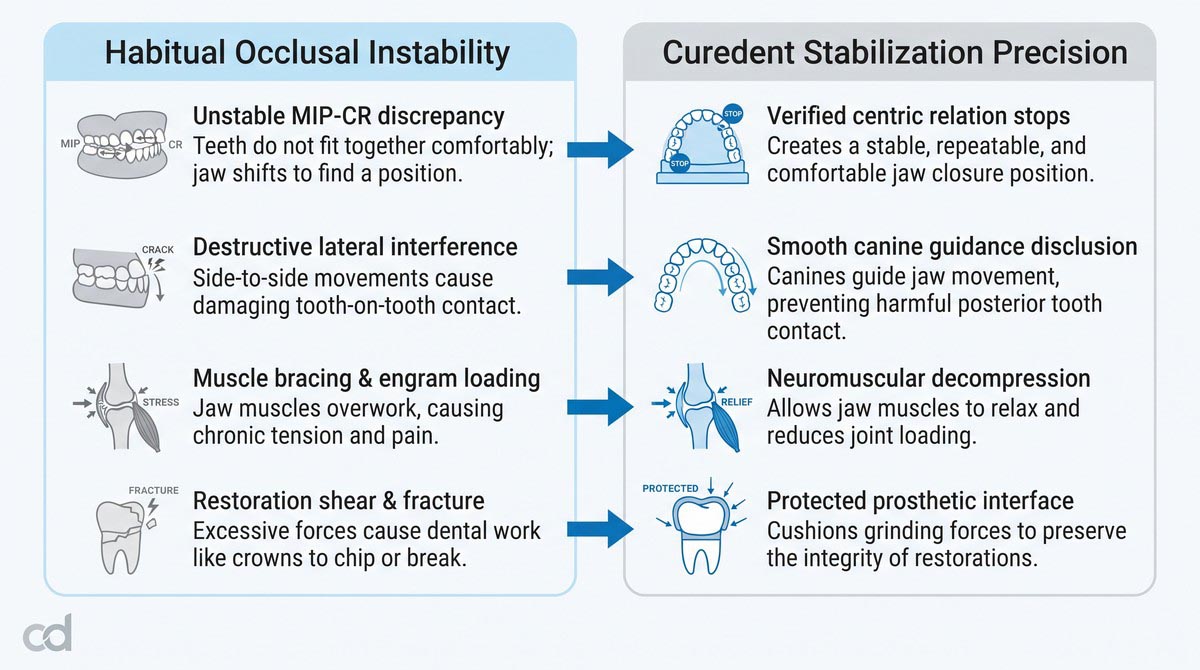
Patients presenting with masticatory muscle hyperactivity, chronic clenching, temporomandibular joint overload, or progressive restoration failure require more than a protective barrier—they require a diagnostic and therapeutic occlusal platform. Unlike simple night guards that merely cushion tooth-to-tooth contact, the Curedent occlusal splint redefines the functional relationship between the arches. It establishes centric relation contact stops, introduces a smooth canine guidance ramp for lateral excursions, and creates immediate posterior disclusion clearance during eccentric movements. This structured occlusal environment reduces elevator muscle hyperactivity, protects ceramic and implant-supported restorations, and provides a stable baseline for full-mouth rehabilitation planning.
Key Clinical Advantages
- Reproducible Occlusal Scheme: Establishes verified centric relation contact stops that can be transferred directly to definitive restorations.
- Predictable Muscle Decompression: Flat-plane occlusal design interrupts habitual muscle engrams and reduces elevator hyperactivity.
- Protection for Complex Restorations: Shields porcelain veneers, implant-supported crowns, and full-arch frameworks from destructive lateral shear.
- Digitally Milled Precision: 5-axis milled PMMA construction delivers uniform surface flatness and stable full-coverage seating without polymerization distortion.
- Diagnostic Foundation: Provides a stable therapeutic platform for pre-prosthetic occlusal evaluation and vertical dimension assessment.

Section 2: Product Anatomy & Physical Construction
Medical-Grade Milled PMMA Matrix
Every Curedent acrylic stabilization appliance is milled from a high-density, medical-grade polymethyl methacrylate (PMMA) blank or a certified Class IIa biocompatible resin, depending on the clinical indication. The material delivers high flexural strength, low water sorption, and dimensional stability under sustained occlusal loading. Unlike hand-poured cold-cure acrylics that exhibit polymerization shrinkage and internal porosity, milled PMMA is fully pre-polymerized, eliminating residual monomer leaching and ensuring uniform density across the entire appliance body.
The Flat Occlusal Table: Engineered Contact Platform
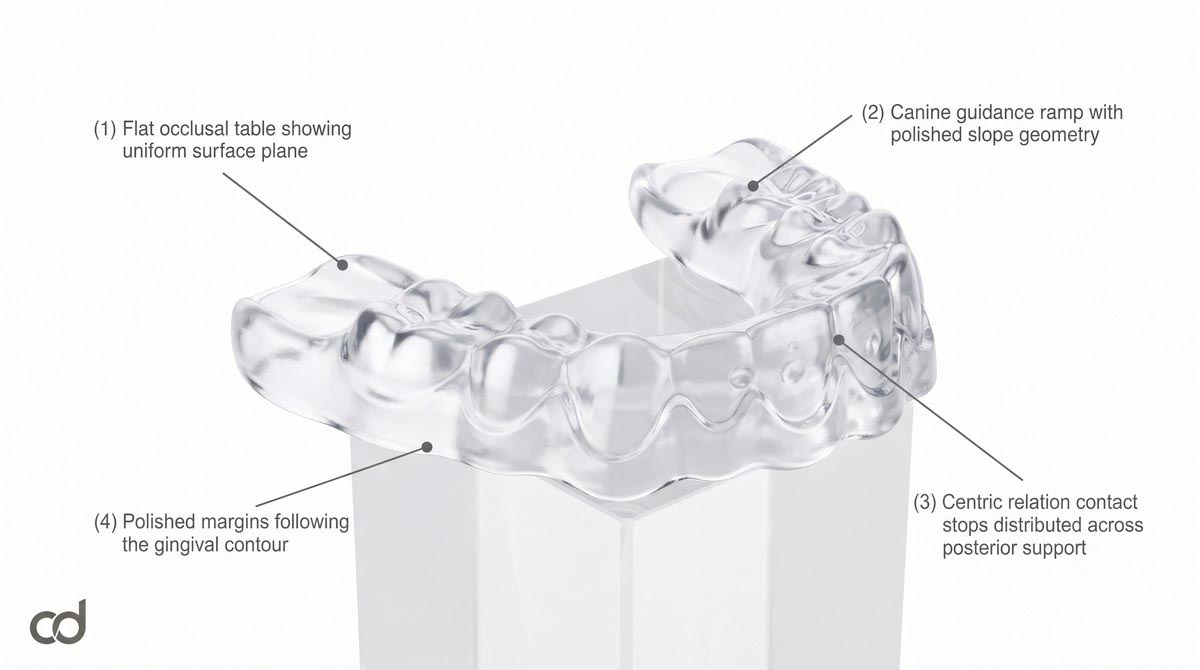
The defining feature of the Michigan-style design is its flat occlusal table. Unlike the anatomical cusp-to-fossa indentations found on night guards, the occlusal surface is milled to a precise, uniform plane. This flat geometry allows opposing cusps to glide freely during eccentric movements without catching, locking, or generating lateral torque. The flat table also ensures that centric relation contact stops are distributed evenly across all posterior support cusps, preventing isolated heavy contacts that could drive muscle bracing.
The Canine Guidance Ramp: Controlled Lateral Disclusion
Positioned anteriorly, the canine guidance ramp is a precisely milled inclined surface that engages the opposing canines during laterotrusive jaw movements. As the mandible shifts laterally, the working-side canine rides up the ramp, immediately separating all posterior teeth. This mechanical disclusion eliminates non-working side interferences, reduces condylar loading, and interrupts the neuromuscular feedback loop that sustains clenching cycles. The ramp slope is digitally calibrated to the patient’s envelope of function and milled with a smooth, polished finish to prevent wear facets.
Centric Relation Contact Stops and Posterior Support
The occlusal surface incorporates centric relation contact stops milled to provide light, simultaneous, bilateral contacts on all posterior support cusps when the condyles are fully seated in their anterior-superior position. These stops serve two critical functions:
- Vertical Support: Prevent over-eruption of posterior teeth during long-term splint wear.
- Reproducible Reference: Provide a stable occlusal baseline that can be transferred to articulator-mounted models during prosthetic treatment planning.
Surface Finish, Thickness, and Marginal Adaptation
The splint body is milled to a case-dependent thickness that balances structural rigidity against interocclusal space requirements. Margins are finished with a smooth, rounded contour that seats 0.5–1.0 mm coronal to the gingival crest, protecting soft tissue while allowing unobstructed oral hygiene. The intaglio surface is polished to eliminate pressure spots and ensure passive seating across the full arch.
Digital Workflow and Milling Precision
[Intraoral Optical Scan (STL/PLY)] ──┐
├─► [Digital CAD Design] ──► [5-Axis Milled PMMA Splint]
[Occlusal Records / Articulator Data]┘
The appliance is designed entirely in CAD from the patient’s optical intraoral scan, occlusal registration, and—when indicated—facebow or articulator transfer data. The digital design is then executed on a 5-axis milling unit, which produces a monolithic splint with uniform surface flatness, precise ramp geometry, and clean marginal contours. This eliminates the variable hand-finishing steps that introduce asymmetry in analog splint fabrication.

Section 3: Indications & Clinical Applications
Primary Clinical Indications
The Curedent Occlusal Splint is indicated across a spectrum of occlusally driven and musculoskeletal conditions:
- Masticatory Muscle Hyperactivity: Chronic masseter and temporalis bracing, morning jaw soreness, and tension-type headaches of occlusal origin.
- Bruxism with Musculoskeletal Symptoms: Nocturnal grinding accompanied by myofascial pain, restricted opening, or joint tenderness.
- TMD-Related Muscle Pain: Acute or chronic masticatory muscle pain requiring neuromuscular decompression before definitive therapy.
- Occlusal Instability: Unstable MIP-CR discrepancy, deflective contacts, or non-working side interferences driving mandibular bracing.
- Pre-Prosthetic Occlusal Evaluation: Diagnostic splint therapy prior to full-mouth rehabilitation, implant restoration, or vertical dimension modification.
Occlusal Splint Feasibility Checklist:
[✓] Stable periodontal status with controlled inflammation
[✓] Controlled caries and no active endodontic pathology
[✓] Sufficient remaining dentition for stable splint seating
[✓] Patient understanding of nightly wear protocol
[✗] Severe uncontrolled TMD requiring surgical referral (Contraindicated)
Case Selection Criteria
- Stable Periodontal Status: Full-coverage splint therapy requires stable periodontal support. Active periodontitis, significant mobility, or acute peri-implant inflammation must be controlled before splint delivery.
- Controlled Caries and Restorative Status: Active carious lesions or fractured restorations should be addressed before splinting, as the appliance provides full-coverage occlusal contact that can exacerbate marginal breakdown under untreated margins.
- Adequate Patient Compliance: Successful stabilization therapy depends on consistent nightly wear. Patients unable or unwilling to commit to a nightly wear schedule are poor candidates.
The Principle of Mutually Protected Occlusion
The Curedent occlusal splint is engineered to reproduce the principle of mutually protected occlusion in a controlled, reversible format. In this scheme, the posterior teeth protect the anterior teeth in centric occlusion by providing stable vertical stops, while the anterior teeth—specifically the canines—protect the posterior teeth during eccentric movements by immediately discluding them.
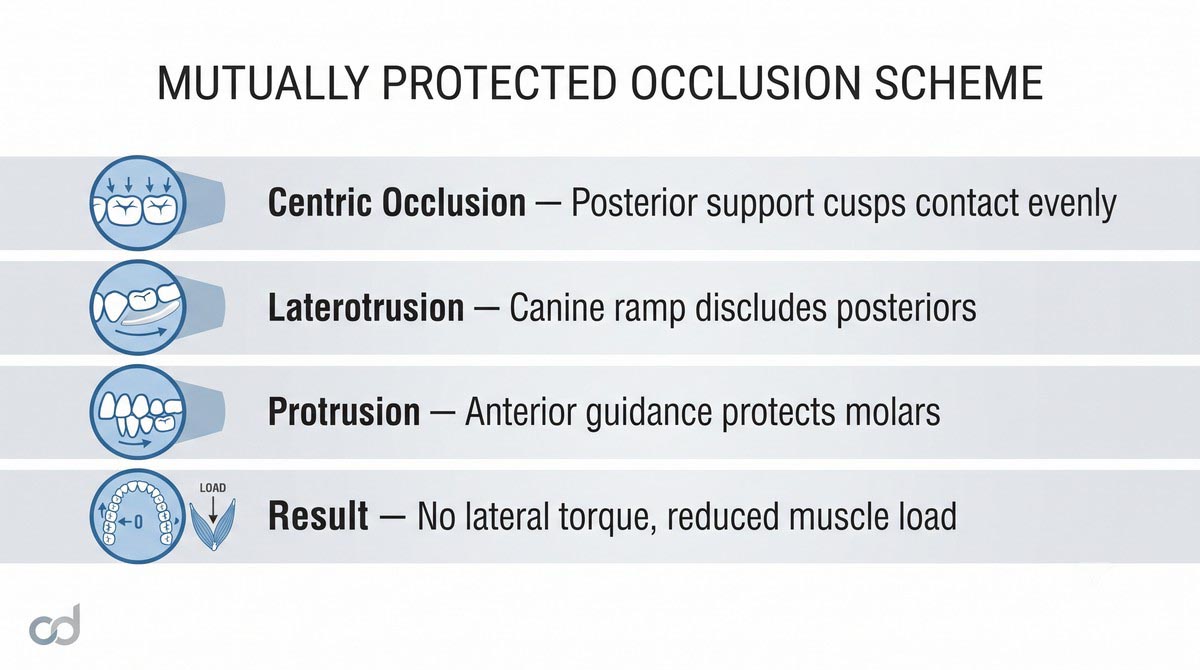
By physically materializing this scheme within the splint, the clinician replaces the patient’s habitual—and often dysfunctional—occlusal pattern with a therapeutic alternative. Over several weeks of nightly wear, this controlled pattern reduces muscle engram loading, allows inflamed tissues to recover, and creates a stable baseline for definitive restorative planning.
Typical Clinical Scenarios
- Pre-Rehabilitation Diagnostic Phase: Patients scheduled for full-mouth reconstruction with suspected MIP-CR discrepancy or unstable vertical dimension.
- Implant Restoration Protection: Patients with implant-supported crowns or full-arch frameworks requiring protection from lateral shear and destructive grinding forces.
- Chronic Tension Headache Management: Patients whose headache history correlates with nocturnal clenching and who show tenderness on masseter and temporalis palpation.
- Post-Orthodontic Occlusal Settling: Patients completing complex orthodontic treatment who need a period of controlled occlusal settling before final retention.

Section 4: Clinical Workflow & Occlusal Function

Step 1: Data Acquisition
Acquire a high-resolution optical intraoral scan of the maxillary and mandibular arches with accurate soft-tissue margin capture. Record the patient’s occlusal registration in centric relation using a bite registration material or digital jaw tracking. When indicated, submit facebow transfer data or articulated model records to support accurate occlusal design.
Step 2: Digital CAD Design
Curedent digital engineers design the splint within a virtual articulator environment. The flat occlusal table is established at the planned vertical dimension, the canine guidance ramp is calibrated to the patient’s envelope of function, and centric relation contact stops are distributed across all posterior support cusps. The clinician reviews and approves the virtual design before milling.
Step 3: 5-Axis Milling and Finishing
The approved design is milled from a medical-grade PMMA blank on a 5-axis milling unit, producing a monolithic splint with uniform surface flatness, precise ramp geometry, and clean margins. The appliance is then hand-polished and inspected for surface uniformity before dispatch.
Step 4: Delivery Verification
Upon receiving the appliance, inspect the splint on the master model: confirm complete seating, verify flatness across the occlusal table, check the canine ramp slope against the digital design, and ensure margins are smooth and rounded.
Step 5: Chairside Seating and Occlusal Verification
- Seat the splint on the maxillary arch using gentle finger pressure across the posterior segments.
- Verify passive seating: the appliance should seat without rocking and remain stable when the patient opens and closes.
- Check centric occlusion with 8-micron articulating paper: confirm light, simultaneous, bilateral contacts across all posterior support cusps with no isolated heavy marks.
- Verify posterior disclusion clearance in laterotrusion: as the patient moves the mandible laterally, the working-side canine should ride up the guidance ramp and immediately separate all posterior teeth. No non-working side contacts should be visible.
- Confirm centric relation contact stops by having the patient close gently into the splint from a slightly opened position. The contacts should reproduce consistently without the mandible sliding or deflecting.
- Inspect the margins: the splint border should rest 0.5–1.0 mm coronal to the gingival crest without blanching soft tissue.

Step 6: Patient Compliance and Wear Protocol
Prescribe full nightly wear for the initial 8 to 12 weeks to allow muscle decompression and neuromuscular adaptation. Patients should insert the splint at least 30 minutes before sleep to allow the musculature to settle. Remove for meals, oral hygiene, and contact sports. Clean daily with a soft toothbrush and non-abrasive soap; avoid hot water and alcohol-based disinfectants.
Step 7: Follow-Up and Contact Refinement
Schedule a review at 4 to 6 weeks to assess patient comfort, muscle symptom resolution, and splint surface wear. Refine centric contacts chairside using fine finishing burs if isolated heavy marks develop. For long-term wear, evaluate the occlusal table every 6 months and re-mill or resurface if significant wear facets compromise the flat plane.
Safety and Hygiene Considerations
Strict hygiene is essential during splint therapy. The appliance should be stored dry in a ventilated case when not in the mouth. Patients should be advised against using boiling water, alcohol-based mouthwash, or abrasive denture cleaners, all of which can degrade the PMMA surface and compromise the flat occlusal plane. During follow-up visits, inspect the intaglio surface for bacterial biofilm accumulation and the occlusal surface for uneven wear that could indicate unresolved parafunctional loading.


Section 5: Technical Specifications & Manufacturing Standards
Certified Technical Specifications
The Curedent Occlusal Splint is manufactured to strict biomedical and dimensional tolerances to ensure predictable therapeutic function and long-term durability.
| Parameter | Specification | Clinical Relevance |
|---|---|---|
| Material | Medical-grade milled PMMA (or Class IIa biocompatible resin) | High rigidity, zero polymerization shrinkage |
| Fabrication method | 5-axis milling (or high-resolution 3D printing) | Uniform surface flatness, precise ramp geometry |
| Occlusal design | Flat occlusal table with canine guidance ramp | Predictable contact pattern, controlled disclusion |
| Occlusal contact scheme | Centric relation contact stops, posterior disclusion in laterotrusion | Reproducible vertical stops, reduced muscle loading |
| Surface finish | Polished, uniform, smooth | Prevents cuspal catch, minimizes wear facets |
| Fit tolerance | Engineered for stable full-coverage seating | Passive seating without rocking |
| Thickness | Case-dependent, rigid | Balances rigidity against interocclusal space |
| Retention type | Full-coverage removable stabilization appliance | Stable retention during sleep |
| Adjustability | Chairside adjustment of contacts possible | Enables fine-tuning after delivery |
| Sterilization | Delivered ready for clinical use | Cleaned and packaged for immediate operatory use |
Surface Flatness and Ramp Accuracy
The therapeutic performance of a Michigan-style splint depends on precise milling tolerances:
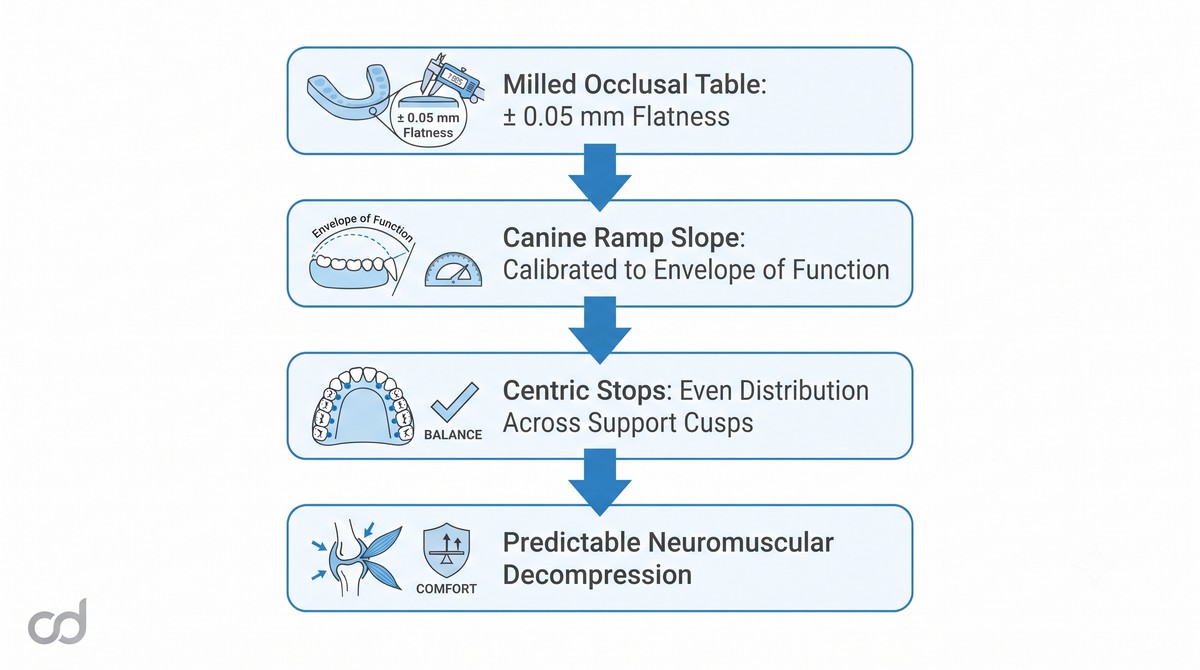
- Occlusal Table Flatness: Mill tolerance is held to ± 0.05 mm across the entire flat plane, ensuring that no localized high spots interfere with even contact distribution.
- Canine Ramp Geometry: The ramp slope and length are calibrated to the patient’s envelope of function based on the digital articulation data, ensuring immediate and complete posterior disclusion.
- Fit Tolerance: The intaglio surface is engineered to seat passively across the full arch, with marginal adaptation tolerances below 0.05 mm.

Section 6: Clinical Benefits & Practice Impact
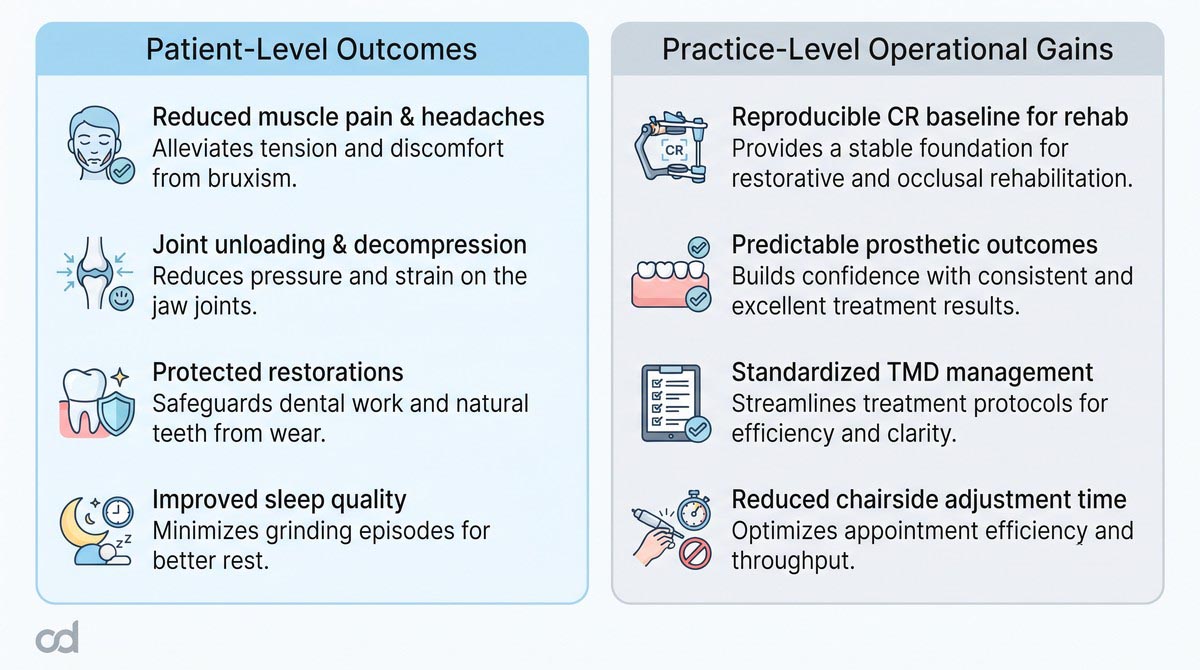
Patient-Level Clinical Benefits
- Reduced Masticatory Muscle Activity: The flat occlusal table and immediate posterior disclusion interrupt the neuromuscular feedback loops that sustain clenching, promoting electromyographic relaxation of the elevator musculature.
- Joint Decompression and Pain Relief: By providing stable centric relation stops, the splint allows the condyles to seat passively in the glenoid fossae, reducing joint loading and associated tenderness.
- Protection of Complex Restorations: Ceramic veneers, implant-supported crowns, and full-arch frameworks are shielded from lateral shear forces that can cause catastrophic fracture under parafunctional loading.
- Improved Sleep Quality: Patients report reduced morning jaw soreness, fewer tension headaches, and more restful sleep once the musculature adapts to the therapeutic contact pattern.
Practice-Level Operational Advantages
- Reproducible Centric Relation Baseline: The splint establishes a verifiable occlusal reference that can be transferred directly to articulator-mounted models, streamlining full-mouth rehabilitation planning.
- Predictable Prosthetic Outcomes: Diagnostic splint therapy reduces the risk of mid-treatment occlusal instability, fractured provisionals, and unplanned vertical dimension corrections during complex restorative cases.
- Standardized TMD Management: The structured workflow—scan, design, mill, verify—allows clinical teams to manage TMD and bruxism cases with consistent, repeatable protocols.
- Reduced Chairside Adjustment Time: Milled PMMA precision means minimal intraoral adjustment at delivery, freeing chair time for diagnostic assessment and patient education.
Michigan Splint Therapy as a Modern Standard
Hand-poured acrylic splints, analog facebow transfers, and chairside occlusal grinding are increasingly incompatible with modern digital restorative practice. Milled Michigan-style stabilization splints provide the surface flatness, contact reproducibility, and structural rigidity that analog fabrication cannot match. Incorporating a Curedent Occlusal Splint into routine TMD and pre-rehabilitation workflows gives clinicians a dependable therapeutic platform that supports predictable long-term restorative outcomes.
Integrating Occlusal Splint Therapy with Other Curedent Appliances
For patients transitioning from acute decompression to long-term protection, the Curedent Occlusal Splint pairs effectively with Curedent Night Guards for severe bruxers requiring additional wear resistance. In cases where orthodontic alignment precedes stabilization, Curedent Clear Retainers provide post-treatment retention while the patient completes diagnostic splint therapy. For full-mouth rehabilitation cases requiring precise occlusal transfer, Curedent Kois Deprogrammer can precede splint delivery to ensure accurate centric relation recording.


Section 7: Ordering, FAQ & Call to Action
Simple Three-Step Ordering Workflow
Ordering the Curedent Occlusal Splint through the doctor portal is designed to be efficient:
[Step 1: Upload Records] ──► [Step 2: Review Digital Design] ──► [Step 3: Receive Splint]
Scan + Occlusal Data CAD Approval via Portal Milled & Polished
- Upload Case Records: Access the Curedent portal and upload the patient’s optical intraoral scans (maxillary, mandibular, and bite registration in STL or PLY format) along with any occlusal registration data or facebow records.
- Review Digital Design: Curedent engineers design the splint within a virtual articulator, establish the flat occlusal table, calibrate the canine guidance ramp, and distribute centric relation contact stops. Review and approve the design via the interactive web viewer.
- Receive and Deliver: Curedent mills the splint from medical-grade PMMA, hand-polishes the surface, verifies flatness and margin adaptation, packages the appliance in protective clinical casing, and dispatches it directly to your practice.
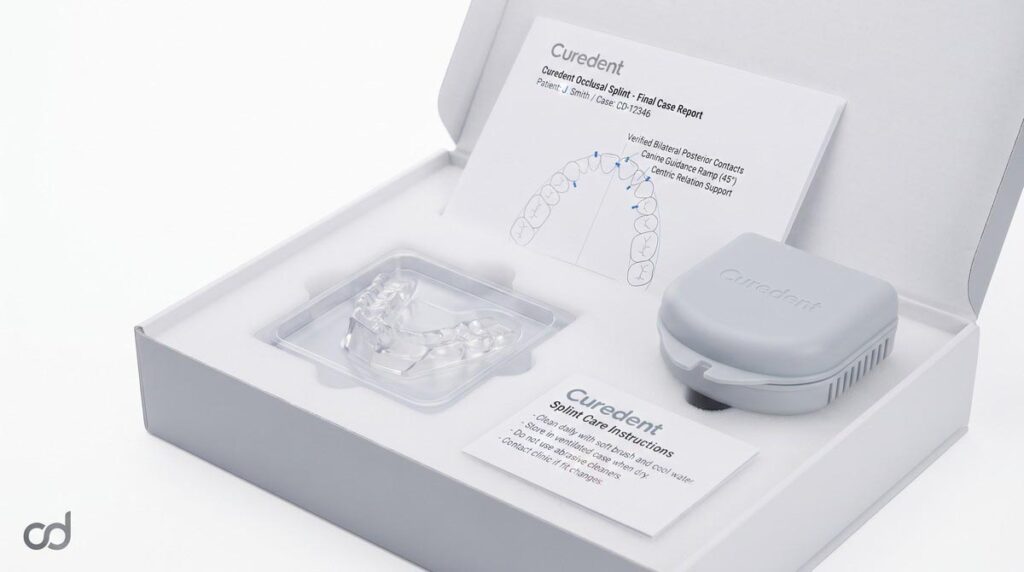
Standard Shipment Package Contents:


Frequently Asked Questions
Do I need a facebow record to order a Curedent Occlusal Splint?
A facebow record is recommended but not mandatory. For straightforward stabilization cases, digital occlusal registration and intraoral scans are sufficient. For full-mouth rehabilitation planning or complex vertical dimension cases, submitting facebow or articulator transfer data improves the accuracy of the occlusal scheme design.
Can I adjust the splint chairside after delivery?
Yes. The milled PMMA surface can be refined chairside using fine finishing burs to adjust isolated heavy contacts. However, because the flat occlusal table is precision-milled, only minor adjustments should be needed after proper digital design.
How long should the patient wear the occlusal splint each night?
Prescribe full nightly wear (6–8 hours) for the initial 8 to 12 weeks. Patients should insert the splint at least 30 minutes before sleep to allow the musculature to settle before unconscious clenching begins. After symptoms resolve, the clinician may transition to a maintenance wear schedule.
How is the occlusal splint different from a night guard?
A night guard is primarily designed to cushion tooth-to-tooth contact and protect enamel from wear. The Curedent Occlusal Splint goes further: it establishes a controlled, reproducible occlusal scheme with verified centric relation stops and programmed posterior disclusion. It functions as both a protective appliance and a diagnostic occlusal platform for treatment planning.
How often should the splint be reviewed and replaced?
Schedule an occlusal review at 4 to 6 weeks after delivery and every 6 months thereafter. Inspect the occlusal table for wear facets and verify that centric contacts remain balanced. Milled PMMA splints typically last 2 to 5 years depending on parafunctional intensity; re-mill when significant surface wear compromises the flat plane.
Suggested Clinical Solutions
- Protect heavy bruxers with additional wear resistance using Curedent Night Guards.
- Ensure accurate centric relation recording before full-mouth rehabilitation with the Curedent Kois Deprogrammer.
- Maintain post-orthodontic alignment during splint therapy with Curedent Clear Retainers.