Section 1: Product Introduction & Clinical Purpose
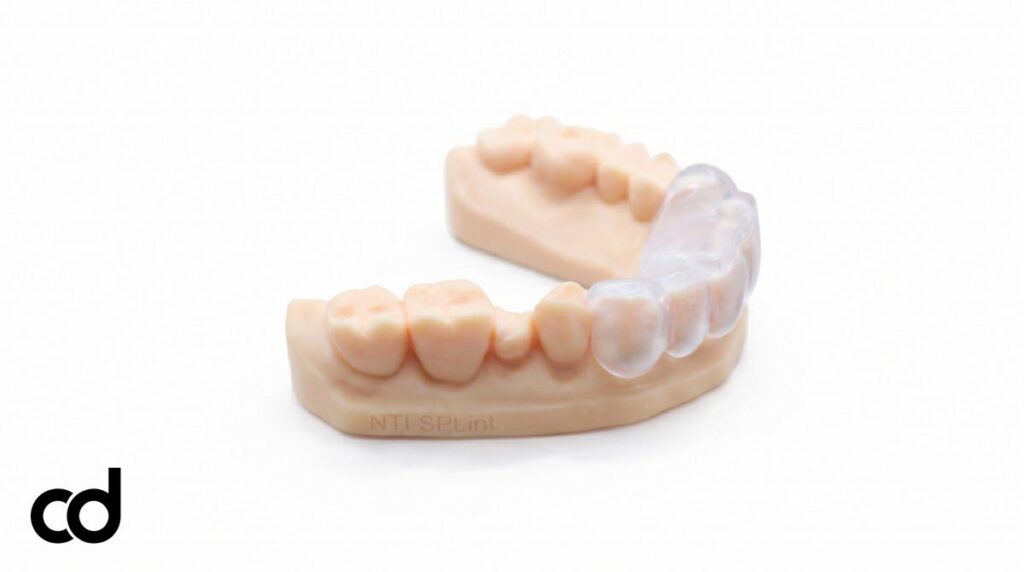
The Curedent Anterior Bite Splint is a precision-milled, anterior-contact anterior bite stop engineered to provide rapid neuromuscular decompression in patients presenting with acute temporomandibular disorder (TMD) muscle spasm, masticatory muscle bracing, or restricted mandibular opening. Developed for general dentists, prosthodontists, TMD clinicians, and gnathology-focused practitioners, this appliance delivers a controlled anterior bite platform that immediately separates the posterior dentition, interrupts the neuromuscular feedback loop sustaining muscle spasm, and creates a therapeutic window for definitive occlusal therapy.
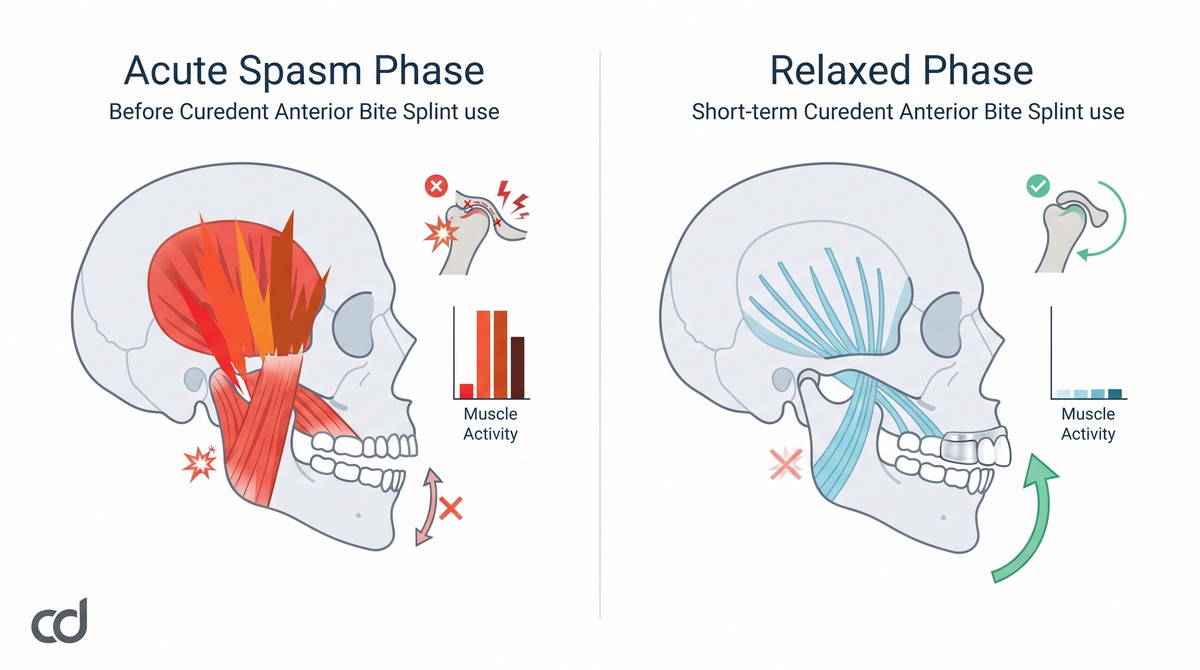
Acute TMD presentations are among the most challenging clinical scenarios in general practice. Patients arrive with significant masticatory muscle pain, limited opening, and often a mandibular position that has deviated from its habitual closure pattern due to protective muscle bracing. Attempting to record centric relation, deliver a stabilization splint, or proceed with definitive restorative treatment in this acute state is clinically unreliable—the muscle spasm masks the true condylar position and prevents accurate diagnosis. The Curedent Anterior Bite Splint solves this problem by providing immediate mechanical decompression. Its anterior bite plane contacts only the opposing anterior teeth, leaving all posterior teeth completely discluded. This controlled separation rapidly releases elevator muscle spasm, reduces lateral pterygoid spasm release time, and prepares the patient for definitive therapy.

Key Clinical Advantages
- Immediate Muscle Decompression: Anterior-only contact removes posterior guidance and interrupts the spasm cycle within minutes of wear.
- Rapid Symptom Relief: Patients typically report significant reduction in muscle pain and improved opening range within the first few wear sessions.
- Stable Diagnostic Reference: Once the musculature releases, the clinician can capture reliable centric relation records for definitive treatment planning.
- Engineered Transition Pathway: Designed as a short-term appliance that bridges directly to a full-coverage stabilization splint for long-term therapy.
- Precision-Milled Construction: 5-axis milled PMMA provides uniform platform flatness and precise anterior contact geometry without polymerization distortion.
Section 2: Product Anatomy & Physical Construction
Medical-Grade Milled PMMA Construction
Every Curedent Anterior Bite Splint is milled from a high-density, medical-grade PMMA blank or a certified Class IIa biocompatible resin, depending on the clinical indication. The material provides high flexural strength, dimensional stability, and biocompatibility under short-term intraoral wear. Unlike hand-fabricated cold-cure acrylic anterior bite appliances that exhibit polymerization shrinkage and irregular contact surfaces, milled PMMA is fully pre-polymerized, ensuring uniform density and precise geometric execution across the entire appliance.

The Anterior Bite Plane: Structural Foundation
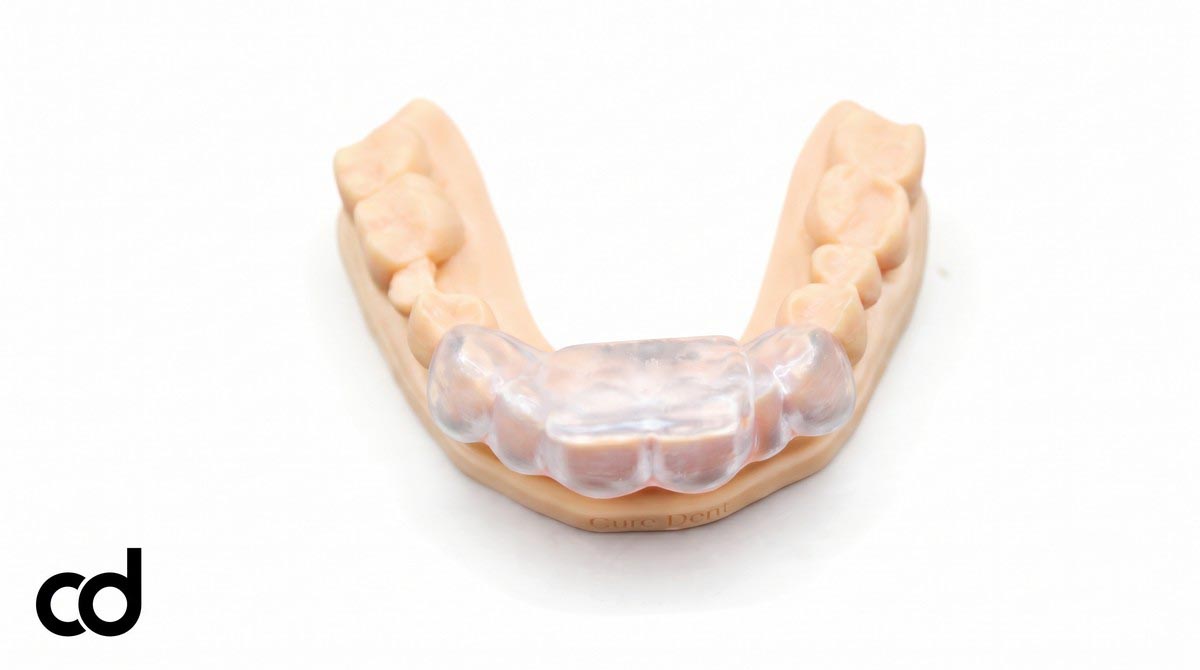
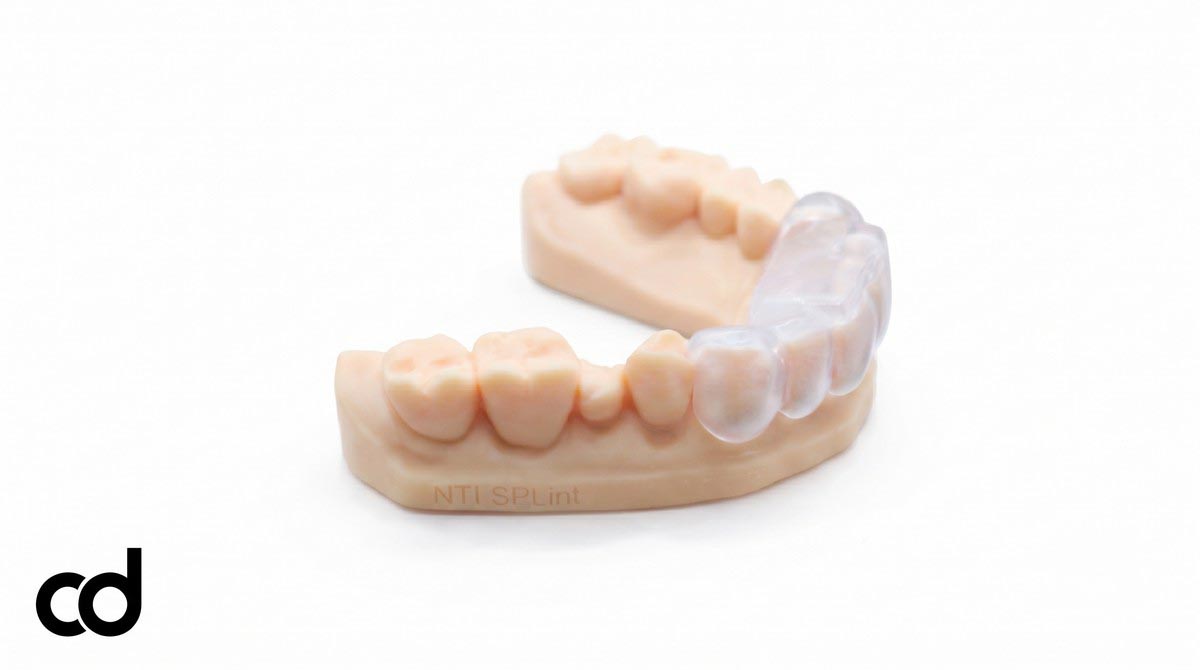
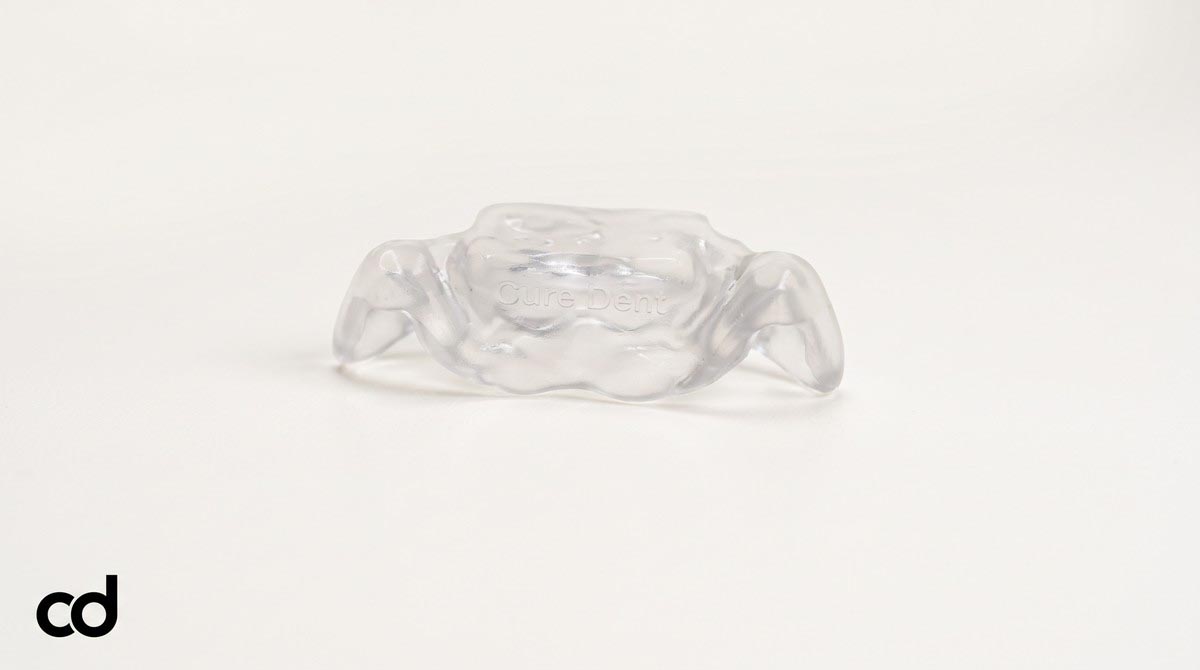
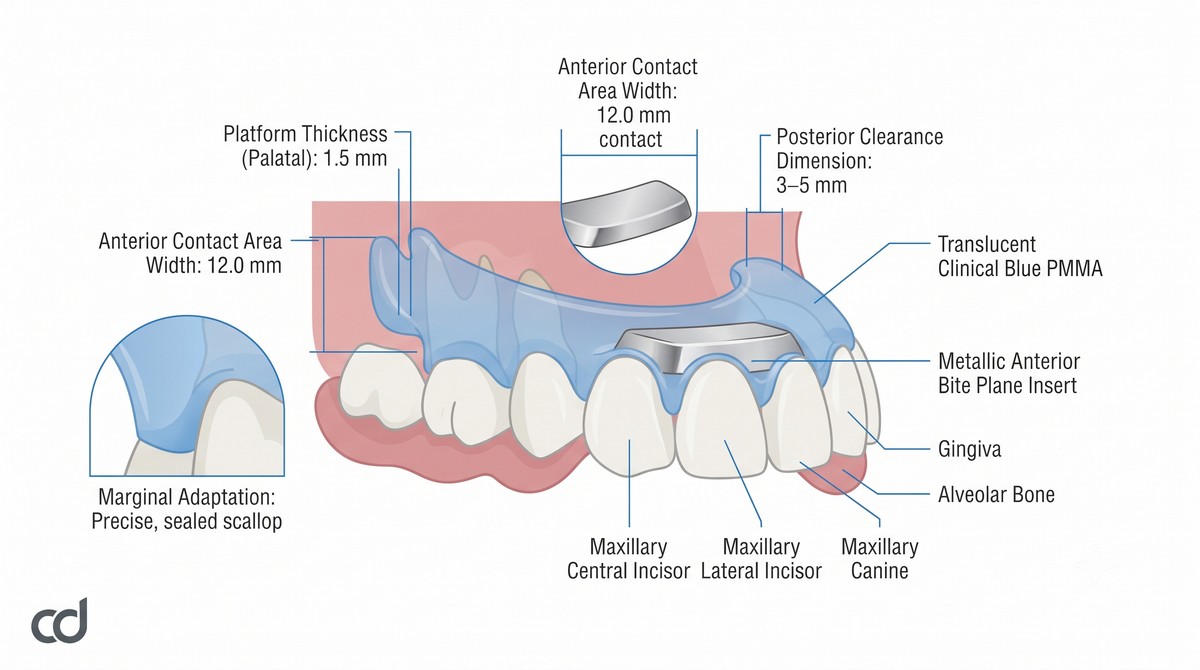
The defining structural feature of the appliance is the anterior bite plane, an elevated horizontal surface positioned over the maxillary anterior teeth. The plane is milled to a precise vertical height that, when the patient closes, establishes a controlled separation between the posterior arches. This separation eliminates posterior tooth contact, removing the proprioceptive and mechanical guidance that sustains the acute muscle spasm.
The Anterior Contact Area: Stable Load Distribution
Unlike the single contact point used in a Kois Deprogrammer, the Anterior Bite Splint features a broader anterior contact area that distributes the patient’s occlusal load across multiple anterior teeth. This design choice reflects the acute clinical context: patients in muscle spasm cannot reliably reproduce a single-point closure, and a broader contact area ensures stable, comfortable seating without inducing additional muscle guarding. The contact surface is milled to a smooth, uniform plane that provides predictable load distribution and prevents lateral deflection during closure.
Posterior Relief Zone: Complete Disclusion
The posterior relief zone is engineered to provide complete disclusion of the posterior teeth during wear. Unlike a partial-coverage appliance that maintains some posterior contact, the Anterior Bite Splint intentionally removes all posterior stops. This is critical: any posterior contact—even light—can reinforce the muscle spasm cycle and prevent effective neuromuscular relaxation.
Surface Finish and Marginal Adaptation
The appliance body is milled to a uniform thickness that balances structural rigidity against interocclusal space requirements. Margins are finished with a smooth, rounded contour that seats 0.5–1.0 mm coronal to the gingival crest, protecting soft tissue while allowing unobstructed oral hygiene. The intaglio surface is polished to eliminate pressure spots and ensure passive seating across the maxillary anterior dentition.
Digital Workflow and Milling Precision
[Intraoral Optical Scan (STL/PLY)] ──┐
├─► [Digital CAD Design] ──► [5-Axis Milled PMMA Splint]
[Acute Phase Occlusal Reference] ┘
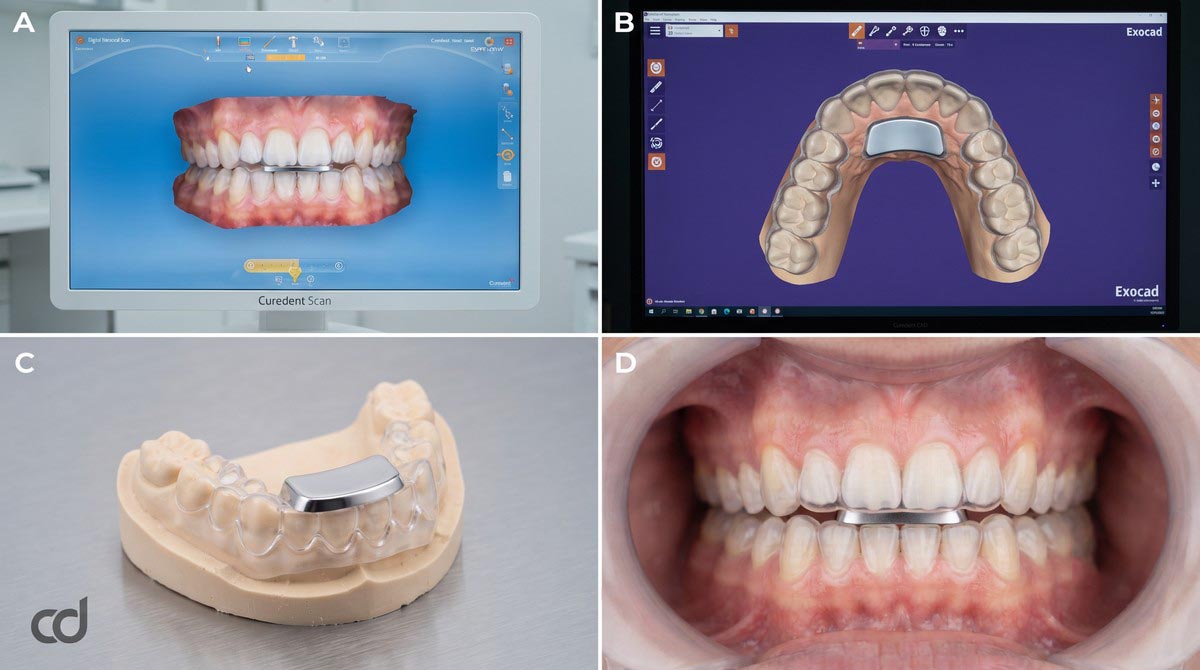
The appliance is designed entirely in CAD from the patient’s optical intraoral scan and available occlusal registration data. Because the patient is in an acute phase, precise CR records may not be obtainable—the digital design therefore prioritizes platform height and contact area geometry over exact CR transfer. The design is executed on a 5-axis milling unit, producing a monolithic splint with precise platform geometry and clean marginal contours.
Platform Height and Its Clinical Function
The anterior bite plane is milled to a specific vertical height calibrated to the patient’s available interocclusal space. This height determines the vertical separation between the posterior arches during wear. Clinical guidelines typically recommend a platform height sufficient to achieve 3–5 mm of posterior separation. This clearance ensures that no posterior cusp contact occurs while the patient closes into the anterior contact area, effectively isolating the anterior guidance from any posterior muscle spasm reinforcement.
Section 3: Indications & Clinical Applications
Primary Clinical Indications
The Curedent Anterior Bite Splint is indicated across a range of acute and diagnostic clinical scenarios:
- Acute TMD with Muscle Spasm: Patients presenting with significant masticatory muscle pain, restricted opening, and protective muscle bracing where immediate decompression is required.
- Acute Closed-Lock Management (Adjunct): As an adjunct to manual reduction or other acute-phase interventions, the appliance supports post-reduction muscle relaxation and prevents recurrent spasm.
- Pre-Treatment Muscle Deprogramming in Acute Cases: When the clinician must record reliable CR but the patient’s acute muscle state prevents accurate bite registration.
- Short-Term Relief Before Definitive Stabilization Therapy: As a bridge appliance, providing rapid symptomatic relief while the patient awaits fabrication of a full-coverage stabilization splint.
Anterior Bite Splint Feasibility Checklist:
[✓] Adequate anterior teeth for stable platform seating
[✓] Controlled periodontal status with no active inflammation
[✓] Sufficient interocclusal space for platform height
[✓] Patient compliance for short-term wear protocol
[✗] Insufficient anterior dentition for platform retention (Contraindicated)
Case Selection Criteria
- Adequate Anterior Dentition: The appliance requires stable maxillary anterior teeth to seat the platform. Mobile teeth, fractured crowns, or missing anterior units compromise seating stability and should be addressed before delivery.
- Controlled Periodontal Status: Active periodontitis, acute peri-implant inflammation, or significant tooth mobility must be controlled before splint wear.
- Sufficient Interocclusal Space: The platform height required to achieve posterior separation must be accommodated within the patient’s available interocclusal space. Patients with severely restricted vertical opening may not tolerate the appliance.
- Reliable Patient Compliance for Short-Term Wear: The appliance is designed for controlled short-term use during the acute phase. Patients must understand and commit to the wear protocol.
The Biology of Acute TMD Deprogramming
Acute TMD with muscle spasm represents a self-perpetuating cycle: pain triggers protective muscle bracing, the bracing restricts mandibular movement, restricted movement sustains the pain, and the cycle repeats. The Anterior Bite Splint interrupts this cycle through acute TMD deprogramming. By providing an anterior-only contact, the appliance removes the posterior tooth guidance that sustains the muscle bracing pattern. Within minutes to hours of wear, the elevator musculature begins to release, opening range improves, and the patient experiences symptomatic relief.

The Clinical Warning: Unopposed Molar Supraeruption Risk
The Anterior Bite Splint is a diagnostic and acute-phase appliance—it is not designed for long-term wear. Prolonged use without posterior support carries a documented unopposed molar supraeruption risk. Posterior teeth, freed from occlusal loading, may begin to erupt vertically within weeks of continuous wear. This risk is especially significant in patients with active eruption potential, younger patients, and those with untreated vertical discrepancies.

Clinicians must clearly communicate the short-term nature of this appliance to patients and schedule a follow-up within 2 to 3 weeks to evaluate the transition to a full-coverage stabilization splint. Any patient reporting posterior tooth sensitivity, occlusal changes, or jaw discomfort during Anterior Bite Splint wear should be evaluated immediately.
Typical Clinical Scenarios
- Acute TMD Flare-Up Management: Patients presenting with sudden onset muscle spasm, restricted opening, and significant pain requiring immediate decompression.
- Post-Traumatic Muscle Bracing: Patients who develop protective muscle bracing following dental trauma, prolonged dental procedures, or acute stress events.
- Diagnostic Bridge Before Full-Coverage Splint: Patients requiring rapid symptom relief while awaiting fabrication of a definitive stabilization appliance.
- Pre-Recording Muscle Decompression: Cases where the clinician must capture reliable CR records but the patient’s acute muscle state prevents accurate bite registration.

Section 4: Clinical Workflow & Deprogramming Protocol

Step 1: Data Acquisition
Acquire a high-resolution optical intraoral scan of the maxillary and mandibular arches with accurate soft-tissue margin capture. Because the patient is in an acute phase, precise CR records may not be obtainable—capture whatever occlusal registration the patient can provide without inducing additional muscle guarding. Note the patient’s current opening range, pain levels, and any deviation from habitual closure.
Step 2: Digital CAD Design
Curedent digital engineers design the splint with a focus on platform height, contact area geometry, and posterior clearance. The anterior bite plane is established at a vertical height sufficient to achieve 3–5 mm of posterior separation. The anterior contact area is milled to a broad, smooth surface for stable load distribution without inducing additional muscle guarding.
Step 3: 5-Axis Milling and Finishing
The approved design is milled from a medical-grade PMMA blank on a 5-axis milling unit, producing a monolithic splint with precise platform geometry and broad contact area execution. The appliance is then hand-polished and inspected for surface uniformity before dispatch.
Step 4: Delivery Verification
Upon receiving the appliance, inspect the splint on the master model: confirm complete seating on the anterior teeth, verify platform height against the digital design, check the anterior contact area for smooth polish, and ensure margins are smooth and rounded.
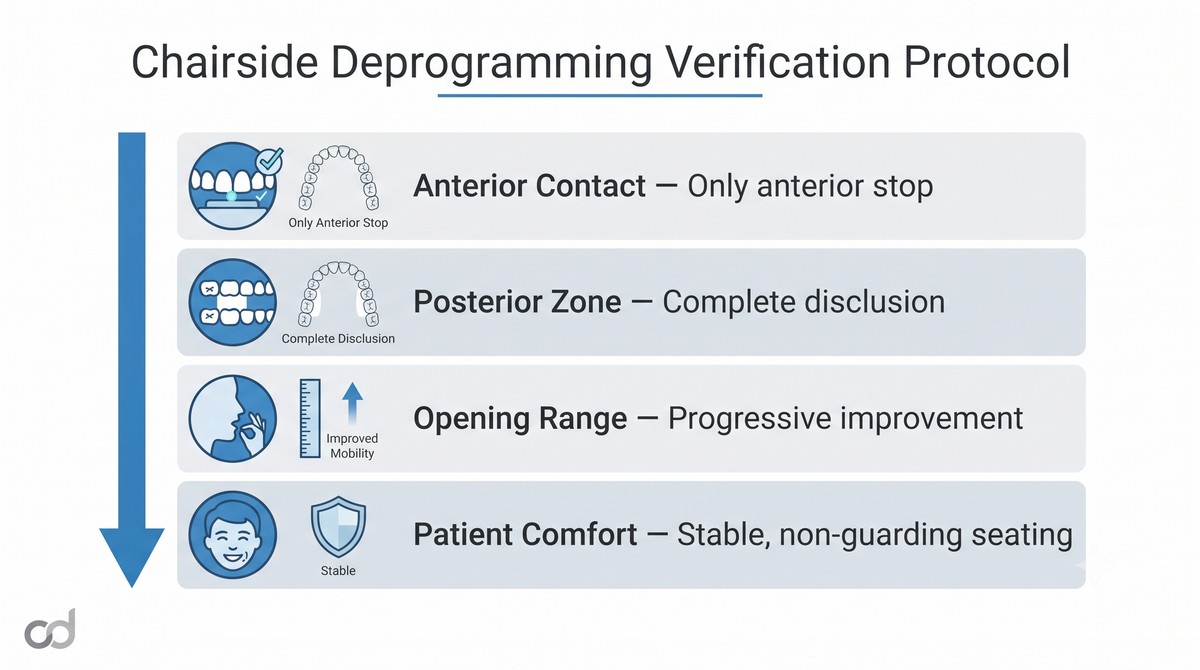
Step 5: Chairside Seating and Posterior Disclusion Verification
- Seat the splint on the maxillary anterior teeth using gentle finger pressure.
- Verify passive seating: the appliance should seat without rocking and remain stable when the patient opens and closes.
- Have the patient close gently into the anterior contact area. Confirm that only anterior contact is present.
- Verify lateral pterygoid spasm release: observe the patient’s mandibular position and opening range after 10–15 minutes of wear. The mandible should gradually release from its protective bracing pattern, and opening range should improve measurably.
- Confirm complete posterior disclusion: no posterior tooth contact should be visible during closure.
- Assess patient comfort: the broad contact area should provide stable seating without inducing additional muscle guarding.
Step 6: Short-Term Wear Protocol and Clinical Re-Evaluation
Prescribe short-term wear of 20–45 minutes per session, repeated 2–4 times daily during the acute phase. The appliance is a diagnostic and acute-phase tool, not a long-term nocturnal appliance. Schedule a follow-up within 2 to 3 weeks to evaluate symptom resolution, opening range improvement, and readiness for transition to a full-coverage stabilization splint.
Step 7: Transition to Full-Coverage Stabilization Splint
Once the acute muscle spasm has resolved, the clinician should transition the patient to a full-coverage stabilization appliance such as the Curedent Occlusal Splint. The transition protocol involves:
- Capturing reliable CR records now that the musculature has released.
- Designing the full-coverage splint with verified centric relation contact stops and programmed posterior disclusion.
- Discontinuing Anterior Bite Splint wear once the stabilization splint is delivered and verified.
Safety and Wear Duration Considerations
The Anterior Bite Splint must be used strictly as a short-term acute-phase appliance. Prolonged wear without posterior support carries a documented risk of unopposed molar supraeruption. Posterior teeth, freed from occlusal loading, may begin to erupt vertically within weeks of continuous wear. This risk is especially significant in patients with active eruption potential. Clinicians must limit wear to the acute diagnostic phase and transition patients to a full-coverage stabilization splint as soon as the musculature has released. Any patient reporting posterior tooth sensitivity, occlusal changes, or jaw discomfort during Anterior Bite Splint wear should be evaluated immediately.

Section 5: Technical Specifications & Short-Term Standards
Certified Technical Specifications
The Curedent Anterior Bite Splint is manufactured to strict biomedical and dimensional tolerances to ensure reliable acute-phase decompression and safe short-term wear.
| Parameter | Specification | Clinical Relevance |
|---|---|---|
| Material | Medical-grade milled PMMA (or Class IIa biocompatible resin) | High rigidity, zero polymerization shrinkage |
| Fabrication method | Precision 3D printing or 5-axis milling | Uniform platform flatness, precise contact geometry |
| Design | Anterior bite plane with posterior relief | Removes posterior guidance, releases muscle spasm |
| Posterior relief | Full posterior disclusion during wear | Eliminates posterior spasm reinforcement |
| Wear duration | Short-term appliance wear only | Minimizes unopposed molar supraeruption risk |
| Surface finish | Polished, uniform | Prevents wear facets and contact instability |
| Fit tolerance | Engineered for stable seating on maxillary anterior teeth | Passive seating without rocking |
| Transition protocol | Designed to bridge to full-coverage stabilization splint | Structured pathway to definitive therapy |
| Retention type | Removable anterior-contact appliance | Stable during acute-phase wear sessions |
| Sterilization | Delivered ready for clinical use | Cleaned and packaged for immediate operatory use |
Platform Flatness and Contact Area Precision
The clinical performance of the Anterior Bite Splint depends on precise milling tolerances:
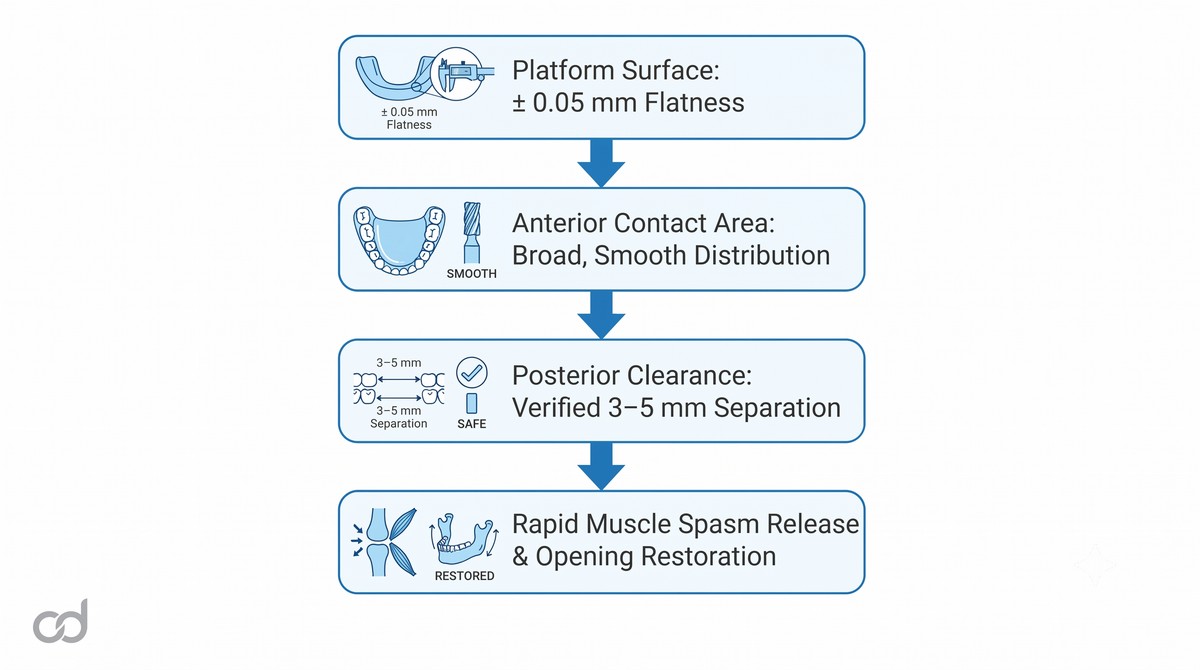
- Platform Flatness: Mill tolerance is held to ± 0.05 mm across the platform surface, ensuring that the anterior contact area provides a stable, non-deflective stop.
- Contact Area Geometry: The anterior contact area is milled to a broad, smooth surface that distributes occlusal load across multiple anterior teeth, reducing the risk of inducing additional muscle guarding.
- Posterior Separation: The platform height is calibrated to achieve 3–5 mm of posterior separation, verified in the digital design and confirmed at chairside delivery.
Short-Term Appliance Wear and Transition Standards
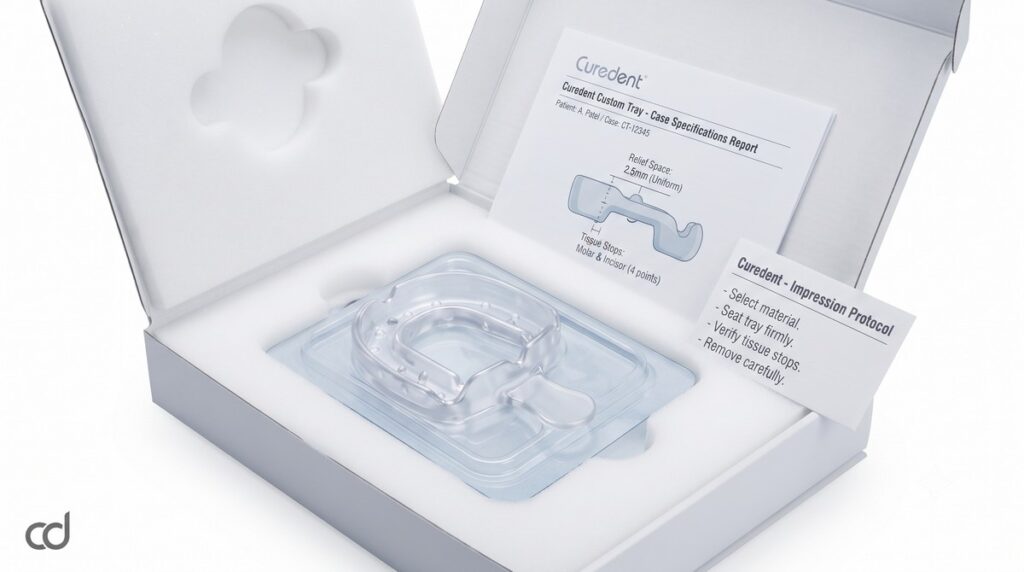
Because the Anterior Bite Splint is designed for short-term appliance wear, the manufacturing workflow includes a documented transition protocol. Every Curedent Anterior Bite Splint is delivered with a printed case report documenting the recommended wear duration, follow-up timeline, and transition criteria. This structured approach ensures that clinicians can manage the acute phase efficiently while protecting the patient from the long-term risks of unopposed molar supraeruption.
Section 6: Clinical Benefits & Practice Impact
Patient-Level Clinical Benefits
- Rapid Symptom Relief: The anterior-only contact removes posterior guidance and interrupts the acute muscle spasm cycle, providing symptomatic relief within the first few wear sessions.
- Progressive Opening Restoration: As the elevator musculature releases, the patient’s mandibular opening range improves progressively, restoring functional capacity and reducing pain.
- Immediate Comfort During Acute Phase: The broad anterior contact area provides stable, comfortable seating without inducing additional muscle guarding—a critical consideration in patients already in pain.
- Easier Transition to Definitive Therapy: Once the acute phase resolves, the clinician can capture reliable CR records and proceed with definitive treatment planning without the confounding influence of muscle spasm.
Practice-Level Operational Advantages
- Routine Adoption of Acute TMD Management Protocols: Integrating the Anterior Bite Splint into the practice workflow standardizes acute-phase management and eliminates the variability that plagues ad-hoc approaches.
- Reduced Chairside Time for Acute Cases: With a structured appliance-based protocol, the clinician can manage acute TMD presentations efficiently without prolonged chairside manipulation.
- Structured Transition to Stabilization Therapy: The Anterior Bite Splint is explicitly designed as a bridge to full-coverage stabilization therapy, creating a predictable clinical pathway from acute presentation to definitive treatment.
- Standardization Across Acute Cases: A structured deprogramming protocol allows clinical teams to manage acute TMD cases with consistent, repeatable workflows.
Anterior Bite Splints in Modern TMD Management
Anterior bite splints are sometimes viewed as a legacy appliance in modern TMD management, superseded by full-coverage stabilization splints. This view overlooks the unique clinical value of the anterior bite splint in the acute phase. When a patient presents with significant muscle spasm and restricted opening, a full-coverage splint cannot be reliably delivered—the muscle state prevents accurate recording and the patient may not tolerate the appliance. The anterior bite splint provides immediate decompression, restores function, and creates the clinical conditions necessary for definitive therapy. The Curedent Anterior Bite Splint modernizes this classic appliance with precision-milled construction, engineered platform geometry, and a structured transition protocol.

Integrating the Anterior Bite Splint with Other Curedent Appliances
The Anterior Bite Splint is the first step in a structured occlusal therapy workflow. After acute decompression, patients transition to the Curedent Occlusal Splint for long-term stabilization. For cases requiring precise centric relation recording before full-mouth rehabilitation, the Curedent Kois Deprogrammer provides single-point deprogramming. For patients requiring dual-arch diagnostic verification, the Curedent B Splint offers comprehensive joint seating assessment.
Section 7: Ordering, FAQ & Call to Action
Simple Three-Step Ordering Workflow
Ordering the Curedent Anterior Bite Splint through the doctor portal is designed to be efficient:
[Step 1: Upload Records] ──► [Step 2: Review Digital Design] ──► [Step 3: Receive Splint]
Scan + Acute Data CAD Approval via Portal Milled & Polished
- Upload Case Records: Access the Curedent portal and upload the patient’s optical intraoral scans (maxillary, mandibular, and available bite registration in STL or PLY format). Note the patient’s current opening range and acute-phase clinical status.
- Review Digital Design: Curedent engineers design the splint with the anterior bite plane and broad contact area. Review and approve the design via the interactive web viewer, confirming platform height and posterior clearance.
- Receive and Deliver: Curedent mills the splint from medical-grade PMMA, hand-polishes the platform and contact area, verifies geometry and margin adaptation, packages the appliance in protective clinical casing, and dispatches it directly to your practice.
Standard Shipment Package Contents:


Frequently Asked Questions
How long can the patient wear the Anterior Bite Splint?
The Anterior Bite Splint is designed for short-term wear during the acute phase, typically days to a few weeks. Prescribe 20–45 minutes per session, repeated 2–4 times daily. Schedule a follow-up within 2 to 3 weeks to evaluate transition to a full-coverage stabilization splint.
Can the Anterior Bite Splint be used long-term?
No. The Anterior Bite Splint is not designed for long-term wear. Prolonged use without posterior support carries a documented risk of unopposed molar supraeruption, which can alter the patient’s occlusal vertical dimension. Transition to a full-coverage stabilization splint as soon as the acute muscle spasm resolves.
How is the Anterior Bite Splint different from a Michigan splint?
A Michigan splint (full-coverage occlusal splint) is designed for long-term stabilization with centric relation contact stops and programmed posterior disclusion. The Anterior Bite Splint is an acute-phase appliance with anterior-only contact and complete posterior relief. It is used to rapidly decompress muscle spasm before definitive stabilization therapy.
When should I transition to a full-coverage splint?
Transition when the patient’s acute muscle spasm has resolved, opening range has improved, and the musculature has released enough to allow reliable centric relation recording. This typically occurs within 2 to 3 weeks of initiating Anterior Bite Splint wear. Capture CR records at that point and proceed with full-coverage stabilization splint fabrication.
How often should I review the patient during Anterior Bite Splint wear?
Schedule a follow-up within 2 to 3 weeks of delivery to evaluate symptom resolution, opening range, and readiness for transition. If the patient reports posterior tooth sensitivity, occlusal changes, or jaw discomfort during wear, evaluate immediately and consider transitioning to a full-coverage splint earlier than planned.
Suggested Clinical Solutions
- Transition to long-term stabilization with the Curedent Occlusal Splint.
- Enable precise CR recording with the Curedent Kois Deprogrammer.
- Verify condylar seating with the dual-arch Curedent B Splint.