

Section 1: Product Introduction & Clinical Purpose
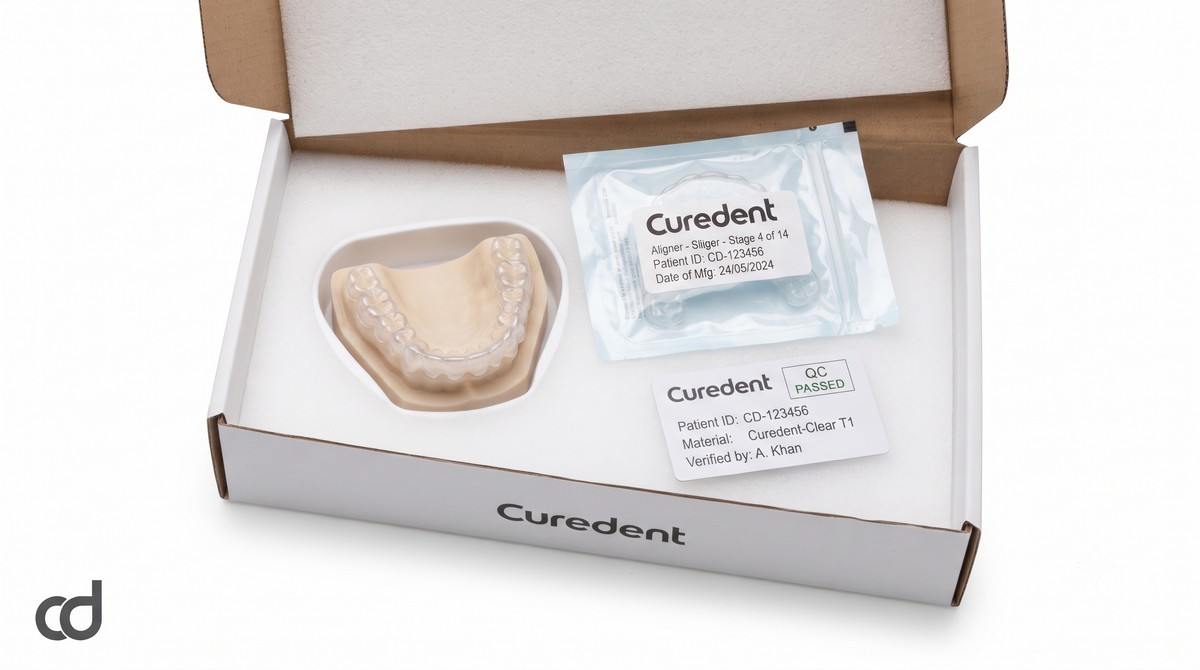
The Curedent Orthodontic Aligner + Model Package is an integrated clinical-laboratory delivery unit that pairs a custom thermoformed orthodontic aligner directly with its corresponding high-resolution physical dental model. Developed for orthodontists, restorative dental practitioners managing clear aligner therapy, laboratory directors, and dental technicians, this synchronized package bridges virtual planning and chairside delivery.
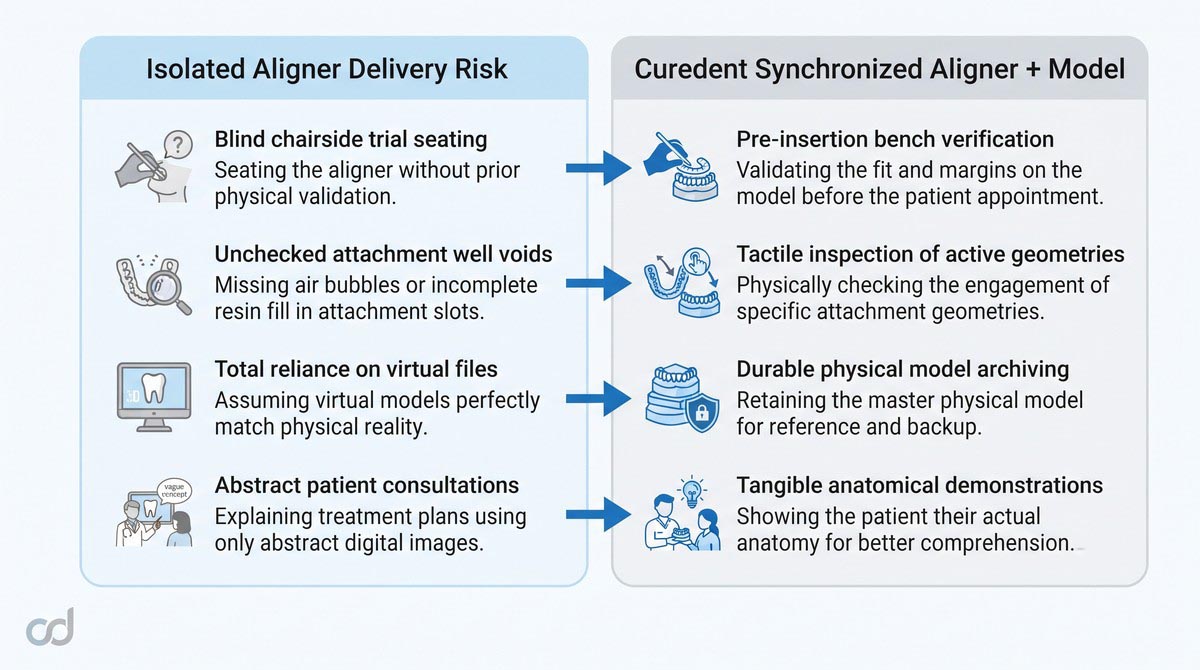
In digital clear aligner workflows, dental offices frequently receive transparent aligner trays as isolated components. When an aligner delivers without its physical master reference, clinicians lose the ability to verify adaptation prior to seating, evaluate attachment pocket geometry, or maintain a tangible record of specific treatment milestones. Implementing an engineered protocol for aligner fabrication alongside matching physical models provides an immediate tactile reference that eliminates fitting uncertainty, protects practice records, and elevates patient communication.
Key Clinical Advantages
- Immediate Pre-Seating Fit Verification: Confirms tray seating, margin adaptation, and attachment well clearance on the matching physical model before patient trial.
- Elevated Patient Engagement: Provides an intuitive anatomical tool to demonstrate tooth movement trajectories, attachment roles, and seating compliance.
- Permanent Milestone Traceability: Retains durable physical records of baseline setups, intermediate movements, or pre-refinement stages.
- Rapid Laboratory Quality Control: Enables instant bench testing of retention, edge-trim accuracy, and insertion-removal forces.

Section 2: Product Anatomy & Physical Construction
Medical-Grade Polyurethane Matrix
The clear aligner is thermoformed from an advanced, biocompatible thermoplastic polyurethane sheet. This multi-layered elastomeric material balances high initial elasticity with sustained orthodontic stress retention. Its molecular composition resists intraoral tearing, micro-cracking, and moisture-induced clouding across standard active wear cycles, maintaining continuous physiological force delivery without sharp force decay.

Additive Resin Master Model Engineering
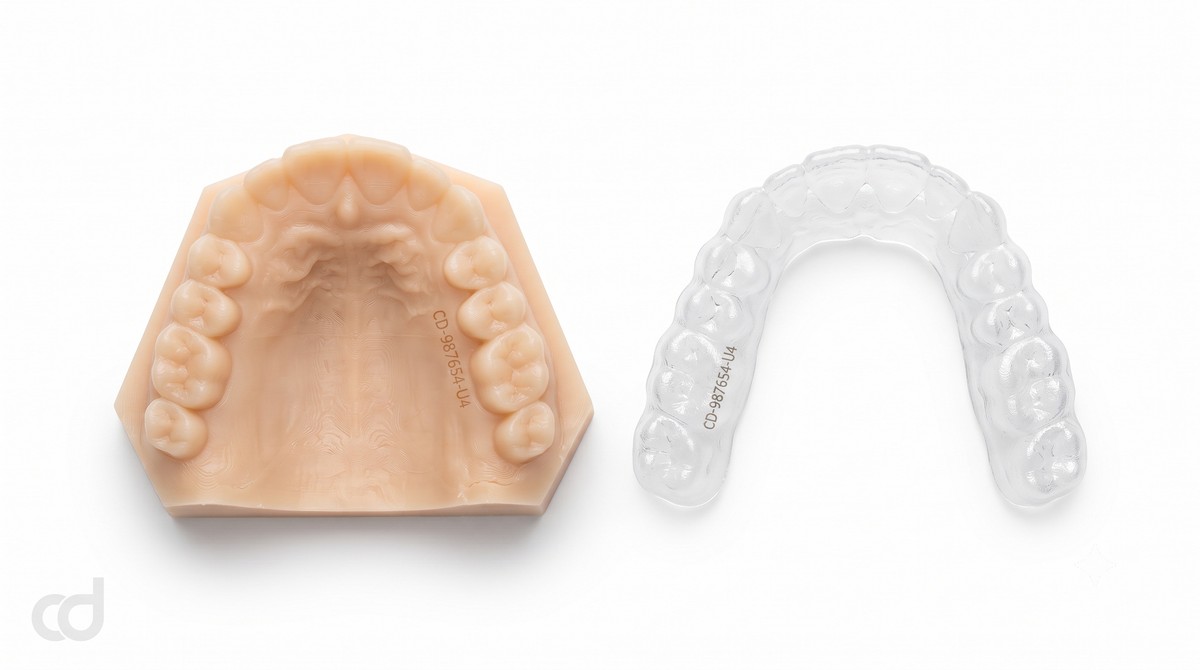
Every paired 3D printed dental model is manufactured from specialized, high-rigidity Class IIa dental modeling photopolymer. Formulated for minimal volumetric shrinkage during UV post-curing, the resin provides high flexural strength and dimensional stability over time. The model features a solid anatomical base with chamfered perimeter borders, flat reference planes, and laser-etched patient and stage identifiers.
Physical Model Pairing and Surface Architecture
The physical relationship between the aligner and its master model is governed by exact geometric matching:
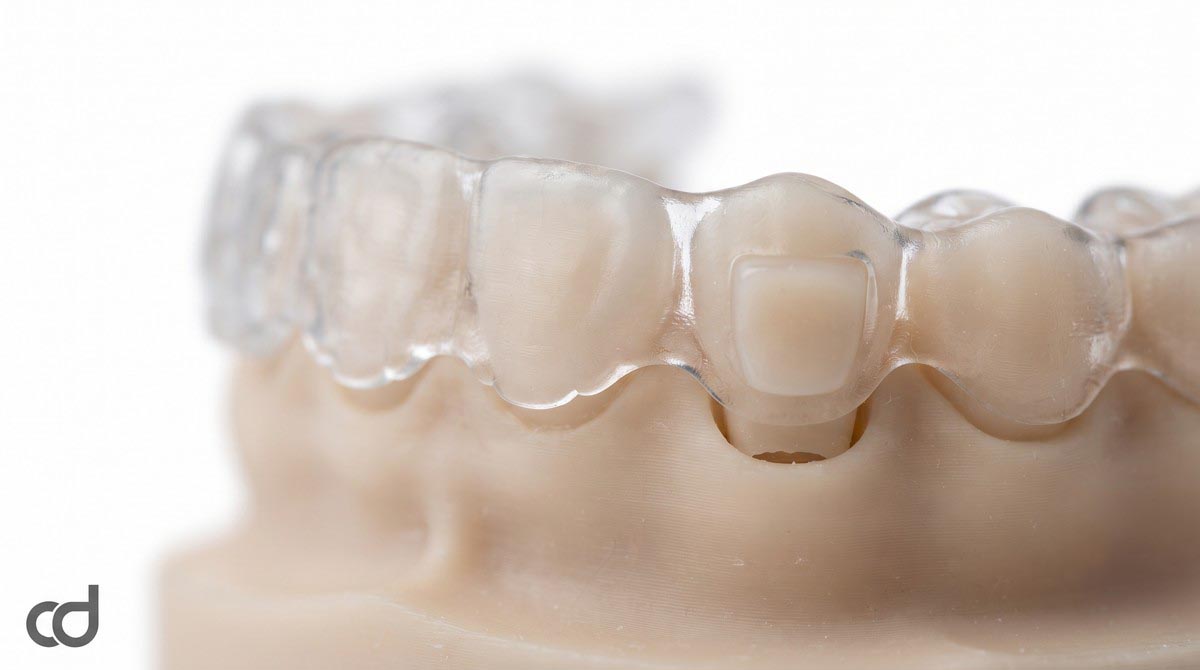
- Attachment Well Replication: The model reproduces composite attachment geometries (rectangular, beveled, ellipsoidal) with crisp edges, ensuring that the thermoformed aligner wells provide precise mechanical force vectors.
- Gingival Contour Calibration: The aligner margin follows a calibrated, smooth scallop positioned 0.5 mm coronal to the free gingival margin. This scalloped trimline maximizes biomechanical retention while preventing soft-tissue impingement.
- Layer Resolution Standards: Printed at ~50 microns per layer, the model surface eliminates coarse staircase stepping along buccal, lingual, and incisal surfaces, yielding a smooth thermoformed inner aligner surface.
From Digital Geometry to Tangible Appliances
The conversion process begins with segmented digital dental meshes (STL or PLY). The digital model is hollowed or solid-based with internal honeycomb cross-bracing to prevent post-cure warpage, sliced into 50-micron horizontal planes, and printed additively. Once washed and cured, this physical master model serves as the thermoforming die. High-pressure forming drives the heated polyurethane sheet deep into occlusal fissures and interproximal embrasures, creating an aligner that matches the model’s physical contours with micron-level fidelity.
Section 3: Indications & Clinical Applications
Pre-Delivery Clinical Verification
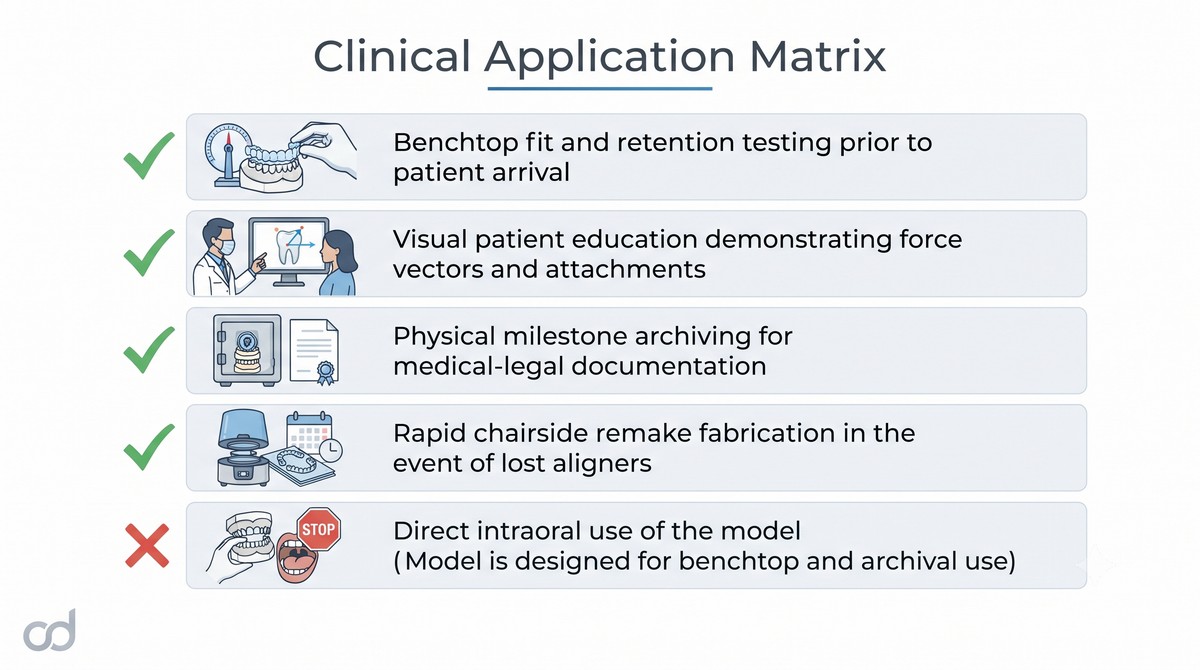
The paired aligner and model package serves as a bench-verification tool prior to patient seating. Before calling the patient into the operatory, the clinician or dental technician can evaluate the physical appliance:
- Inspect tray insertion and removal path to ensure severe undercuts do not cause excessive binding.
- Verify attachment well depth and alignment against planned composite buttons.
- Confirm that interproximal contact relief areas are unhindered by thermoforming thinning or pooling.
Chairside Patient Education and Consultation
Communicating clear aligner mechanics to patients using computer monitors alone can feel abstract. Presenting an aligner paired with its matching physical model transforms the consultation:
- Demonstrates how the aligner grips composite attachments to steer teeth.
- Shows the patient how to seat and remove the tray safely without distorting the plastic borders.
- Illustrates why consistent 20–22 hour daily wear is mandatory to advance between physical milestones.
Pressure Thermoforming Precision and Fit Assurance
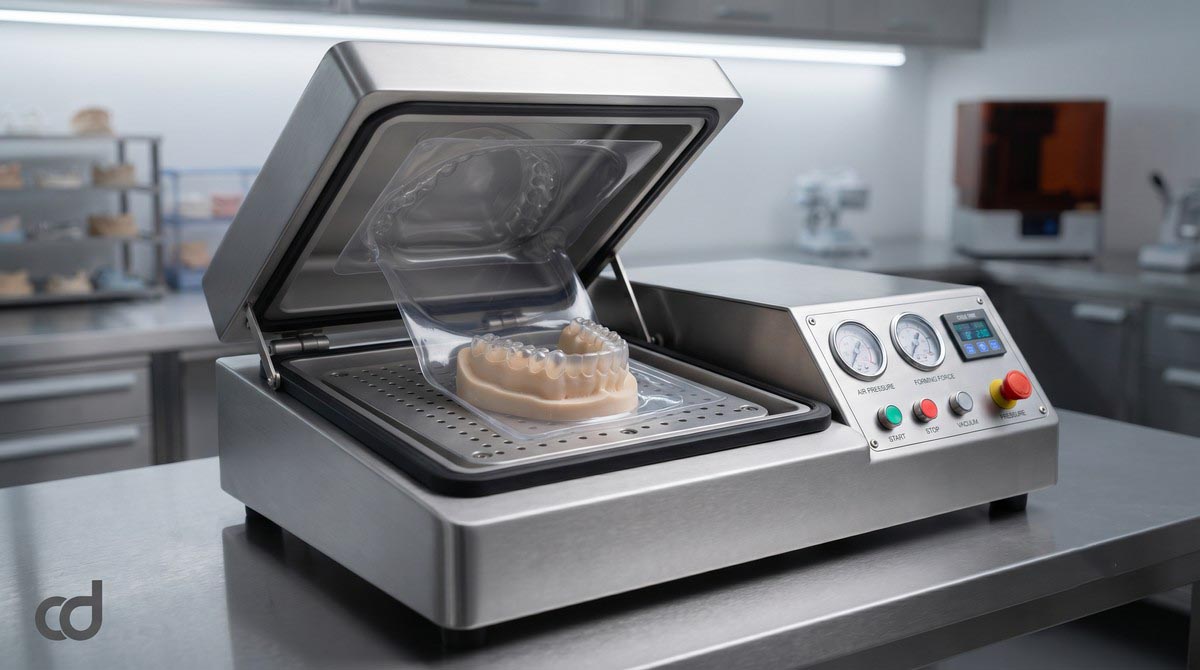
A primary advantage of utilizing physical models during production is the mechanical fidelity achieved through pressure thermoforming. Unlike basic vacuum-forming systems that rely on 1 bar of atmospheric suction, Curedent utilizes high-pressure thermoforming chambers operating at 4 to 6 bars. This positive pressure forces the heated polyurethane sheet into intimate contact with every interdental embrasure and line angle of the printed model, delivering consistent dimensional accuracy.
Typical Clinical Use Scenarios
- Complex Movement Monitoring: Cases involving large canine rotations, root torque, or premolar space closures where physical bench confirmation verifies attachment well geometry before patient delivery.
- Emergency Replacement Contingency: Providing the patient’s current milestone model allows the clinic to fabricate an emergency replacement tray in-office if an aligner is lost or damaged during treatment.
- Restorative-Orthodontic Coordination: Interdisciplinary cases where the physical model assists the restorative team in evaluating clearance, tooth contours, and pontic spacing.

Section 4: Clinical & Manufacturing Workflow
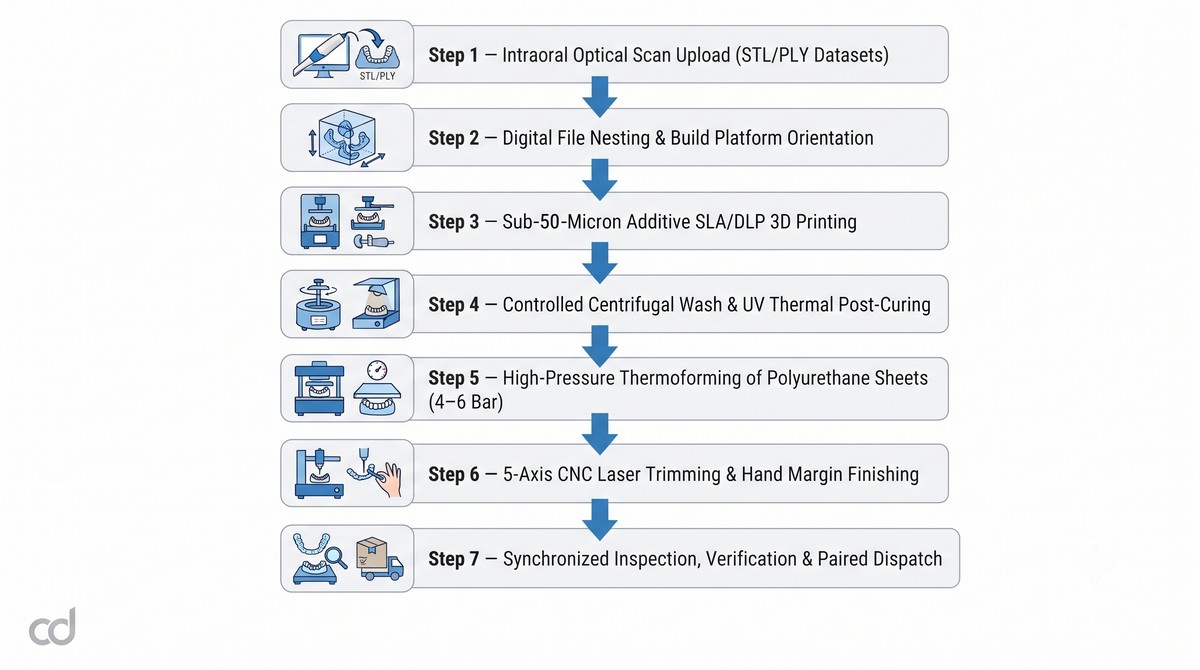
Step 1: Digital Record Ingestion
Acquire high-resolution optical intraoral scans capturing full-arch dentition, gingival architecture, and accurate interocclusal records. Upload the open-format STL or PLY datasets to the Curedent portal.
Step 2: Digital File Nesting and Platform Setup
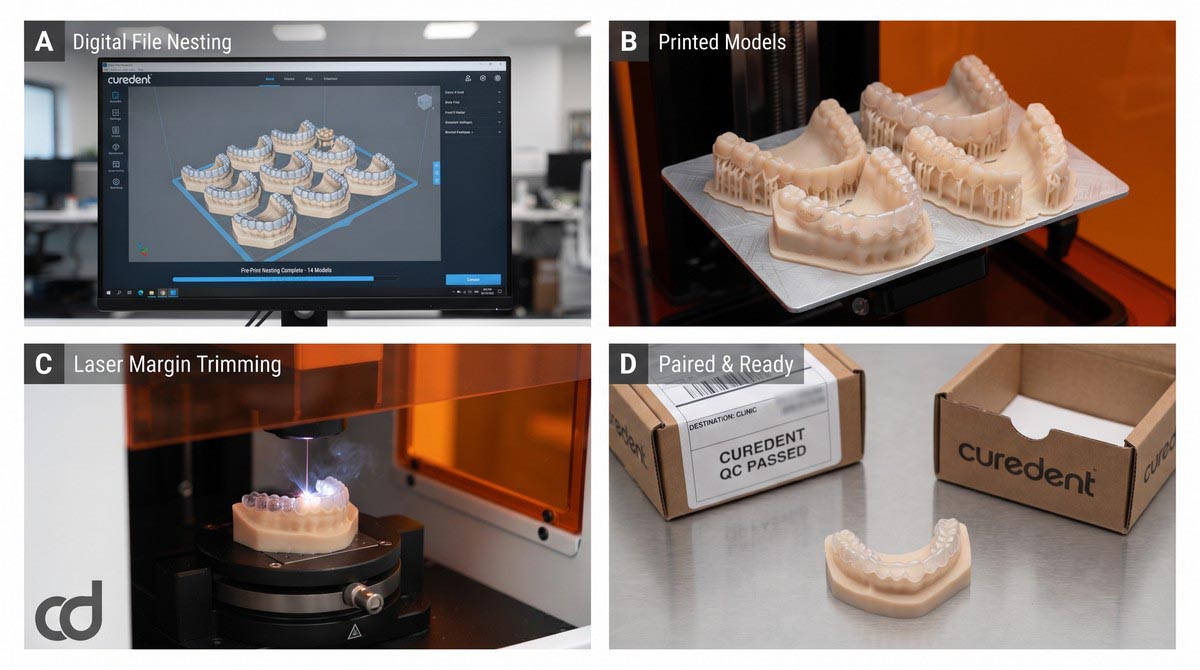
Curedent digital technicians prepare the models for additive production. Through optimized digital file nesting, individual arches are aligned across the virtual build plate at optimal angles (15-30 vertical tilt) to balance build speed, minimize support-pin contact on critical tooth surfaces, and prevent resin suction cupping.
Step 3: High-Resolution Additive Printing
The nested print files execute on DLP/SLA 3D printers using medical-grade model photopolymers. Layer thickness is held to ~50 microns, ensuring that every developmental groove and attachment site is captured with high fidelity.
Step 4: Post-Processing and Thermal Curing
Printed models undergo automated isopropyl alcohol (IPA) centrifugal washing to strip uncured liquid monomer without softening fine surface details. Models are thoroughly dried and transferred into calibrated UV thermal curing chambers to finalize polymer cross-linking, eliminating residual monomers and stabilizing model dimensions.
Step 5: Precision Model Replication and Pressure Thermoforming
To guarantee precision model replication, every model is dimensionally audited against digital coordinates before thermoforming. The model enters the high-pressure forming chamber, where a multi-layer polyurethane sheet is heated to its target plasticizing temperature and formed over the resin model under 4–6 bars of positive pressure.
Step 6: Laser Trimming and Margin Polishing
The thermoformed aligner is separated and trimmed using automated 5-axis CNC laser cutters or hand-scalloped with fine carbide burs. Margins are smoothed to remove sharp flash, preserving a clean 0.5 mm offset from the gingival crest.

Step 7: Final Matching and Synchronized Dispatch
The finished aligner is reseated onto its matching model for a final quality check. Both components are labeled with the patient’s unique case ID, packaged together in protective, clinical-grade packaging, and dispatched directly to the practice.
Material Safety, Biocompatibility, and Handling
The thermoformed aligner is fabricated from medical-grade, non-cytotoxic polyurethane that is BPA-free, phthalate-free, and resistant to intraoral fluid degradation. Aligners arrive cleaned and ready for clinical trial. The accompanying resin model is designed for benchtop and archival use; it should be cleaned using neutral disinfectant sprays and kept out of direct sunlight or high-heat environments ($>60^\circ\text{C}$) to prevent thermal distortion.
Section 5: Technical Specifications & Quality Standards
Certified Technical Specifications
The Curedent Orthodontic Aligner + Model Package is manufactured to strict biomedical and dimensional tolerances, ensuring reliable physical verification throughout aligner therapy.
| Parameter | Specification | Clinical Relevance |
| Aligner material | Biocompatible thermoplastic polyurethane sheet | High elasticity, persistent orthodontic forces |
| Model material | High-resolution 3D printed dental resin | High rigidity, low volumetric cure shrinkage |
| Model print resolution | ~50 microns per layer | Captures micro-anatomy without surface stepping |
| Aligner fabrication method | Pressure thermoforming over printed model | 4–6 bar pressure ensures intimate dental adaptation |
| Trimline finish | Precision laser or hand-trimmed | Smooth 0.5 mm supra-gingival scalloped margin |
| Aligner fit tolerance | Engineered for stable seating on printed model | Passive bench fit without frictional binding |
| Pairing standard | Aligner matched one-to-one with its case model | Dedicated reference pair per treatment stage |
| Model archiving | Physical model retained as case record | Permanent physical milestone documentation |
| Sterilization | Aligner delivered ready for clinical use; model for archiving | Complies with safe dental operatory protocols |
| Case traceability | Case ID labeled on both aligner and model | Eliminates mix-ups across multi-patient cases |
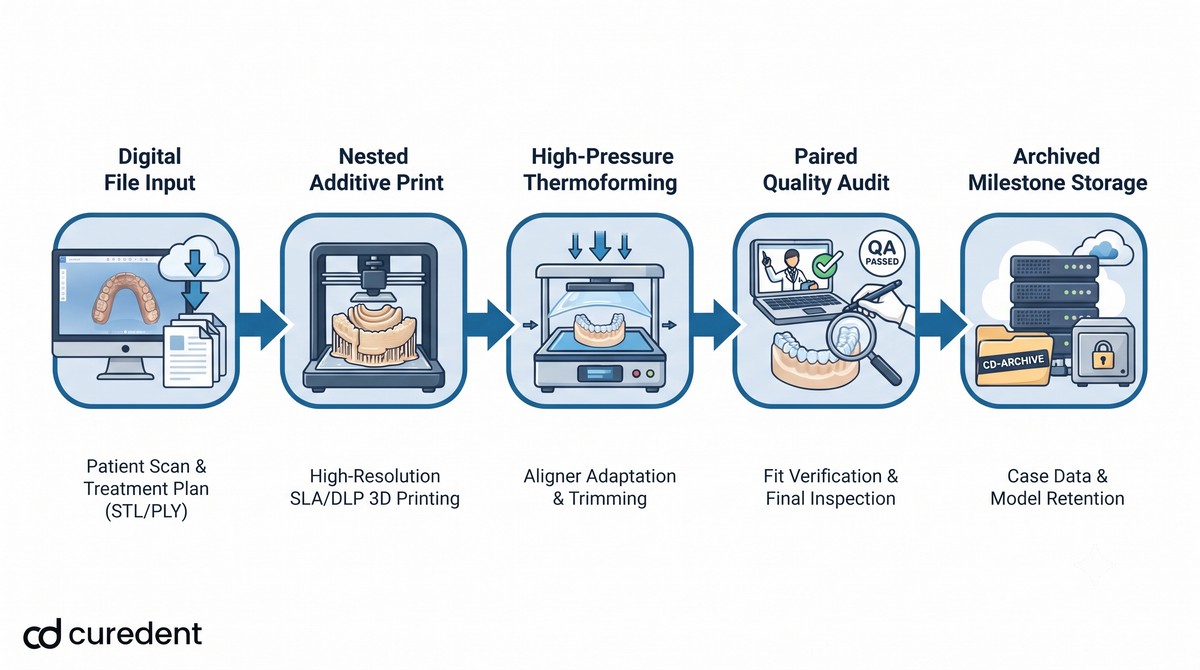
Physical Model Archiving and Case Record Integrity
Incorporating physical model archiving into your clinical workflow establishes a dependable tangible record:

- Dimensional Stability Over Time: Unlike dental stone plaster that chips or degrades upon repeated insertion, cured dental model resin retains its dimensional fidelity over multi-year storage periods.
- Milestone Record Keeping: Archiving physical models of primary milestones provides an objective reference in the event of patient compliance disputes or significant mid-course tracking shifts.
- Laser-Marked Traceability: Every aligner and model carries matching laser-etched case numbers, stage designations, and arch indicators, preventing mix-ups in busy group practices.
Section 6: Clinical Benefits & Practice Impact

Patient-Level Clinical Benefits
- Verified, Smooth Initial Fit: Because the tray is pre-fitted and audited on its matching physical model at the laboratory bench, patients experience a comfortable, passive fit without painful edge binding or sharp margins.
- Clear Comprehension of Treatment Steps: Handling a physical model of their own teeth helps patients visualize the planned movements, improving motivation and compliance with daily wear schedules.
- Confidence in Professional Care: Receiving an aligner alongside an individualized master model demonstrates a high standard of customized care, reinforcing patient trust in your practice.
Practice-Level Operational Advantages
- Elimination of Chairside Fitting Surprises: Checking the aligner on its physical model before bringing the patient into the operatory allows clinical teams to identify undercuts or attachment clearance issues in advance, saving valuable chair time.
- Streamlined Case Handoffs: Clinical assistants can verify tray numbers, arch alignment, and attachment wells against the physical model, standardizing the appliance delivery routine.
- In-Office Remake Contingency: Having the patient’s current milestone model on hand allows the clinic to thermoform a temporary replacement tray in-office if an aligner is lost, keeping treatment on track without waiting for lab transit.
- Structured Practice Overhead: Synchronizing aligner and model delivery within a single lab order avoids separate shipping cycles, keeping laboratory costs organized and predictable.
The Value of Physical Verification in a Digital Era
Digital dentistry provides speed and planning flexibility, but patient treatment takes place in the physical world. Relying solely on virtual screen setups without physical verification can leave clinical teams vulnerable to unexpected tracking errors or fitting delays. Delivering aligners paired with their matching 3D-printed master models combines digital planning precision with the dependability of tactile quality control.

Section 7: Ordering, FAQ & Call to Action
Simple Three-Step Ordering Workflow
Ordering the Curedent Aligner + Model Package through the practitioner portal is straightforward:
[Step 1: Upload Scan Data] ──► [Step 2: Select Aligner + Model] ──► [Step 3: Receive Paired Kit]
Intraoral Optical STL/PLY Specify Arch & Stage Count Delivered in Protective Box
- Upload Case Records: Access the Curedent portal and upload the patient’s optical intraoral scans (upper, lower, and bite registration in STL or PLY format).
- Select Paired Production: In the prescription dashboard, select the “Orthodontic Aligner + Model” option. Specify which treatment stages require paired physical models (e.g., all active stages, specific milestones, or final retention stage).
- Receive and Deploy: Curedent prints the models at 50-micron resolution, pressure-thermoforms the polyurethane aligners, performs quality cross-audits, packages the pairs in protective casing, and dispatches the kit directly to your office.
Standard Shipment Package Contents:

Frequently Asked Questions
Can I order only the clear aligner without the 3D-printed model?
Yes. Curedent supports flexible production options; you can order standalone clear aligners, standalone 3D-printed models, or the synchronized aligner + model package depending on your clinical requirements.
Can I order only the 3D-printed model if I prefer to thermoform aligners in-office?
Yes. Practices equipped with in-office pressure-forming units can order standalone high-resolution 3D-printed models to handle thermoforming, trimming, and finishing on-site.
What intraoral scan file formats does Curedent accept?
The Curedent portal accepts open-format STL and PLY surface scan files from all major intraoral scanner systems, including iTero, 3Shape TRIOS, Medit, Carestream, and Dentsply Sirona.
Is the 3D-printed dental resin model reusable for multiple thermoforming cycles?
Yes. Curedent models are printed from high-strength dental modeling photopolymer that withstands the heat and pressure of secondary thermoforming, allowing you to fabricate replacement aligners or temporary retainers on the same model.
How should the physical models be stored for long-term archiving?
Store models in a cool, dry area away from direct sunlight, UV curing sources, and excessive heat ($>60^\circ\text{C}$). Stored in standard clinic organizers, the cured resin maintains its dimensional stability for years.
Suggested Clinical Solutions
- Deliver lasting post-treatment stability with Curedent Clear Retainers.
- Structure comprehensive tooth movement sequences across Curedent Tiered Aligner Packages.
- Fine-tune minor residual discrepancies with a targeted Curedent Orthodontic Refinement Plan.


